On Saturday, the gates of the St. Elizabeths Hospital east campus will be thrown open to the public, marking the next stage in the long, gradual redevelopment of the Congress Heights landmark.
During a tour of the 180-acre campus earlier today, Ethan Warsh, a project manager in the office of the Deputy Mayor for Planning and Economic Development, showed off some of the century-old buildings marked for renovation, and other parcels of land where entirely new structures will go up in the coming years.
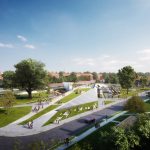
The St. Elizabeths project contains a “huge amount of economic planning for Ward 8,” Warsh said. In time, the District would like to see the site to be home to schools, corporate offices, new housing, dining and retail. “We really hope to fold the fabric of the campus into the fabric of the community,” Warsh said.
By his estimation, St. Elizabeths is the largest undeveloped tract of land in the District, though there are many existing buildings that, because of their historic preservation statuses, are not going to disappear in the future.
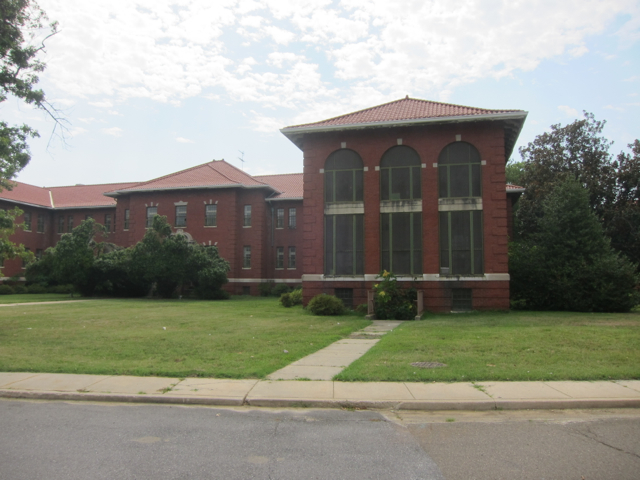
St. Elizabeths dates back to 1852, when it opened as the first federally operated hospital for the mentally ill, but the east campus started as a tilling field; agricultural work was thought to be therapeutic. In time, as the hospital expanded, structures like Building 100, in the heart of the east campus, sprouted up with their stone archways and terracotta roofs.
“There’s a lot of historical architecture in D.C., but this really strays from the style,” Warsh said.
Building 100 is idealized as the future home of a facility devoted to innovation and entrepreneurship, Warsh says. “It’s the core of the programmatic identity.” In recent months, the District has been banking on Microsoft some day building an “Innovation Center” at St. Elizabeths.
But Innovation Centers, or really any type of construction project, are still a long way off. Warsh’s office is playing the role of master developer with matter-of-right zoning being declared on a parcel-by-parcel basis, but it’s a slow process. Engineering teams just recently finished reviewing the campus’ existing utility and roadway systems to determine if any of the existing infrastructure—constructed separately from the District’s main grid—is salvageable. Being completely private systems, most streetscapes and plumbing systems will need to be replaced from the ground up.
“A lot of years will pass before we can deliver this project,” Warsh says. “We want to realize services to the community by delivering amenities.”
Between the 2013 and 2016 fiscal years, the District projects spending $113 million on upgrades to St. Elizabeths’ roads, street lighting, sewage systems and electrical grid, with half of that amount allocated for the coming year. A request for contractor proposals will be published later this year. By the time the renovations are complete, the District hopes that the first construction projects—a row of newly built townhouses stemming off Martin Luther King Jr. Avenue SE—are complete.
Like everything else the District has planned for St. Elizabeths, those townhouses and a matching multi-family structure are several years away. Right now, the east campus is a quiet, almost desolate wasteland of buildings that have gone unused for years, their windows shattered and entrances overgrown with shrubbery, remnants of when St. Elizabeths Hospital moved into its new facility in spring 2010.
But this weekend, St. Elizabeths will see its first signs of life in a long time when its hosts a festval kicking off what the District is billing as a “Season of Discovery,” including the Ward 8 farmers’ market, live musical performances, art exhibits and, perhaps most importantly, an opportunity to show off the St. Elizabeths master plan. The music and art is just for Saturday, but more events are in the works.
Next year, a sturdier temporary pavilion will be erected to provide the coming influx of federal workers with a lunch-hour venue to which DMPED hopes to bring in food trucks and other vendors.
Still, more of St. Elizabeths looks like the buildings of the Maple Quadrangle, a collection of stately brick buildings that once housed psychiatric wards, outpatient facilities and thousands of healthcare workers and patients, but today sit crumbling and covered in vines.
Warsh is optimistic, though, that in the not-too-distant future, St. Elizabeths will live up to its master plan and become a community full of enviable jobs, smartly designed domiciles and lively retail. It’s a rare opportunity afforded to D.C.
“Any city would be lucky to have this,” he says.