Martin Austermuhle
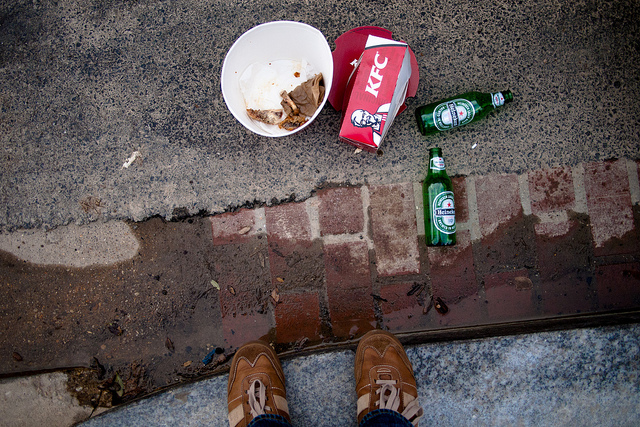 Photo by JosephLeonardo
The Metropolitan Police Department is expanding an anti-littering pilot program this week, empowering officers in the Sixth District east of the Anacostia River to hand out $75 tickets to people caught throwing trash on the ground.
While littering has been illegal in D.C. since 1985, it wasn’t until 2008 that the D.C. Council got around to clarifying clarifying exactly how litterbugs could be punished and last year for MPD to start punishing them. While D.C. law allowed a police officer to stop someone from littering, they lacked the ability to force the person to identify themselves—making it virtually impossible to guarantee that an accused litterbug would pay the ticket or respond to the citation.
This technicality made it so that dumping trash out of your car window would saddle you with a fine—an officer could ask to see a drivers’ license after pulling you over, after all—but not if you were quietly walking down a neighborhood side street and dropped a soda can on the ground. Anti-littering advocates were incensed, noting that D.C. can spend north of $20 million a year picking up street trash and that dirty streets tended to be unsafe streets.
As of last May, that changed. It was then that police in the Fourth District—encompassing most of Ward 4 and parts of northern Ward 5—were given the authority to not only write the $75 littering tickets, but also threaten litterbugs with an additional ticket of $100 to $250 for failing to properly identify themselves. In short, littering finally became a punishable crime.
Starting this Wednesday, the same anti-littering program will expand to the Sixth District. After a 30-day grace period, anyone caught littering there will be subject to a ticket—and even arrest. At some point thereafter, the enforcement will expand citywide.
But the beefed-powers may not do as much as some people would like. Through the end of 2011, only 12 tickets for littering were written in the Fourth District—and only two of those were paid. In the first five months of 2012, only two more tickets were written. Even tickets for littering from a vehicle are down—in 2009, 225 tickets for littering from a vehicle were issued, while in 2010 and 2011 that number dropped to 64.
Even MPD seems to understand the challenge its officers face in enforcing littering laws. “Without repercussions for an offense, the government’s ability to hold violators accountable for this civil offense is limited, and the tickets may not be enough of an incentive to motivate people to change their behavior,” said the department’s end-of-the-year assessment.
Allowing police to enforce littering laws rests on a simple premise—that a police officer will actually see someone in the act of littering. I live in the Fourth District, and I can safely say that the anti-littering pilot program hasn’t helped dissuade my local litterbugs from dropping their trash on the sidewalk.
Fighting that will take much more than simple police enforcement though—a wholesale change of culture for those who think littering is OK is necessary, advocates say. To that end, in 2008 DPW kicked off “Not in OUR DC! Pledge to Keep the Capital Clean,” a program targeted at city youth that encouraged them to act against graffiti and litter.