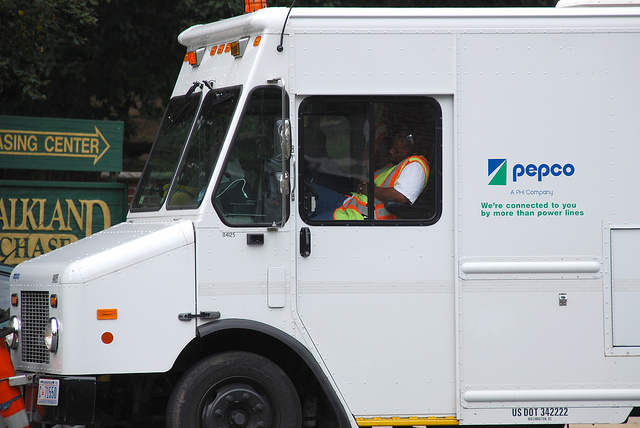
District residents aren’t just united in their general mistrust for the local government. According to a poll by The Washington Post, they’re just as down on the local electric company.
Pepco, unsurprisingly, fared quite poorly in the survey, which was conducted in the wake of a violent derecho storm that knocked out service to nearly 76,000 of the company’s D.C. customers, many of whom languished in the dark for several days of an oppressive heat wave that followed the storm.
Thirty-three percent of respondents to the Post’s poll said they lost power for more than 24 hours because of the June 29 storm. And 23 percent reported being in the dark for more than one day.
The company’s service record was even more dismal. More than half of those surveyed rated Pepco’s response to the storm as “not so good” or “poor.” Again, hardly shocking. After all, Pepco is the company whose apparent lethargy in restoring power after the derecho prompted one group of Bloomingdale housemates to bang out an obscenity-laden diss track about slogging through several days 100-degree temperatures without electricity.
But as much as D.C. hates Pepco, the city is far from unified in supporting a solution that would cut down on the number of power outages. Burying D.C.’s power lines underground would reduce power failures, but it would also be an expensive undertaking, costing more than $6 billion.
And many the Post surveyed were unwilling to pay a little extra on their Pepco bill to see that accomplished after considering the price, the Post reports:
A 2010 study done for the D.C. Public Service Commission estimated that burying all of the city’s aboveground power lines would cost nearly $6 billion. Spread out among all D.C. ratepayers over a 30-year period, Pepco has estimated that such an effort could add more than $100 a month to the average bill.
Less drastic measures, such as burying only primary lines known as “feeders,” would be significantly less costly, but poll results show that even a modest increase in power prices would be a tough sell.
Of the 47 percent of people willing to pay something extra for burying power lines, the average sum is about $20.
A cheaper solution would be to bury only the “feeder” lines, which would cost between $1 and $1.5 billion. Charging an extra $2 a month to all of Pepco’s 252,000 residential customers in D.C. would raise about $6 million a year, while an additional $11 a month per customer would net about $33 million. Over 30 years, the Post reports, that could raise enough money to bury the feeder lines.
But that doesn’t change the fact that Pepco is deeply unpopular. With 55 percent of respondents saying it did a bad job of cleaning up the mess left by the derecho, it rates even worse among D.C. residents than the general direction of the city. In another Post poll, 45 percent said the District is headed in the wrong direction, and 54 percent called on Mayor Vince Gray to resign.
Pepco’s unpopularity is greater than either of those numbers.