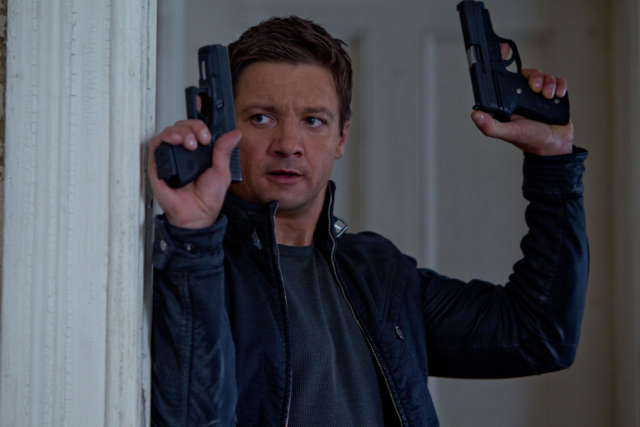
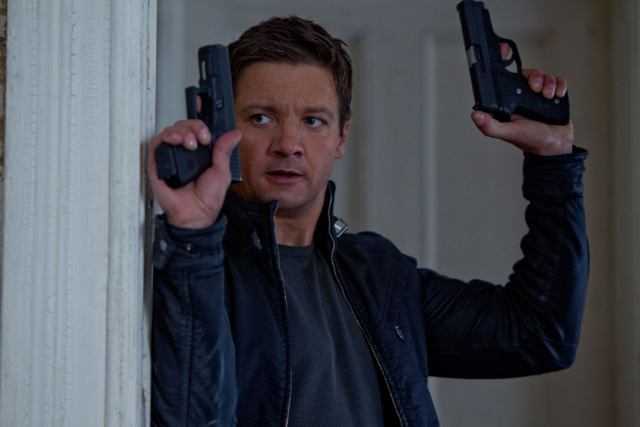
 Jeremy Renner in The Bourne Legacy. (Mary Cybulski/Universal Pictures)
Tony Gilroy, penning his fourth script in the Jason Bourne series, made perhaps the smartest decision any action writer has made in a long time: In a Hollywood marketplace of countless franchise reboots in which memorable stars are replaced for younger models (see Maguire, T. swapped out for Garfield, A.), The Bourne Legacy is, refreshingly, a mostly smooth continuation from where The Bourne Ultimatum left off and not a total reset.
Jason Bourne, played across three post-9/11 espionage movies by Matt Damon, still haunts the world, but only because Legacy begins just as Ultimatum is ending. Gilroy, now taking the director’s reins, splices in a few bits of the Paul Greengrass-helmed Ultimatum so cleanly they feel like fresh footage. But Damon is nowhere to be seen, other than a dated mugshot on Bourne’s CIA dossier.
Instead, Jeremy Renner steps in as Aaron Cross, an equally lethal lone wolf of a supersoldier. And I use the phrase “lone wolf” quite literally, because as Legacy opens, Renner is skulking about in the Alaskan wilderness, diving in icy pools and battling hungry wolfpacks.
But where Bourne was introduced as a complete amnesiac, Cross is somewhat aware of his condition. He knows he is a participant in Operation Treadstone, the Bourne series’ chief conspiracy, now fleshed out even more to reveal that its agents are dependent on a pharmaceutical cocktail whisked up by unsuspecting geneticists. Where Damon played a man struggling to find himself, Renner gets to be a drug addict.
Of course, as a compatriot of Bourne’s, that also makes Cross a targeted man. By the time Legacy gets going, Operation Treadstone is in shutdown mode, and Gilroy’s government spooks don’t offer the friendliest of severance packages. Some industries offer commemorative watches and six months’ salary; Cross is presented with the business end of a Predator drone.
The chase winds from the northern, snowy woods to what a Washington Post investigative series called Top Secret America. Shadowy black-ops agencies hiding in nondescript office buildings and scientific facilities around the Beltway collaborate on truly frightening intelligence assets. One participant in these dark operations is Marla Shearing a pharmacologist played with almost constant fear by Rachel Weisz. Her work is the grease that moves the plot along, but most of Weisz’s work involves a balance of screaming, running and cowering.
Some veteran baddies from the first three Bourne movies—Albert Finney, David Strathairn and Scott Glenn—appear briefly, as if to pass the baton of skullduggery to a new cloak-and-dagger set. Edward Norton is a top man in the National Research Assay Group, a bureau with a name so convoluted, one wonders if it doesn’t have a real-life counterpart. Just a few weeks ago, Norton was charming as the bumbling scoutmaster in Wes Anderson’s terrific Moonrise Kingdom. Here, he is cruel and relentless as he hunts down Cross and Shearing. His compatriots, played by Stacy Keach and Donna Murphy, are just as chilling.
 Rachel Weisz and Jeremy Renner in The Bourne Legacy. (Mary Cybulski/Universal Pictures)
As the chase continues, the threads from Damon’s entries slip out of thought, if not relevance. There are questions raised by The Bourne Ultimatum that are unanswered and forgotten by the time Renner and Weisz are running around Manila deep in the second act. And some provided answers, like Cross’ own backstory, are a little underwhelming.
That’s not all bad, though. Gilroy has always been an efficient writer, his 2009 misfire Duplicity aside, and having written the first three Bourne movies (he shares this one with his brother Dan), he is not in unfamiliar waters. The Bourne Legacy isn’t as intricate as Michael Clayton, Gilroy’s debut feature as director, but it doesn’t have to be. Like its hero, Cross, the film is a blunt instrument with heightened senses. It’s a more intelligent summer diversion, something to keep spy-movie fans occupied until that debonair British fellow comes raging back in November.
And it helps that as much as Damon grew into the Bourne role, his successor is a more credible action star. It’s almost odd to say that about Jeremy Renner, who is baby-faced and quick with a joke, whereas Damon was always ready to explode. Renner seems more dangerous. Maybe it’s his compact, muscly torso—something that gets plenty of screen time—or, more likely, that Renner excels as pre-programmed national-security types. Renner was like an automaton in his breakout role as a bomb technician in The Hurt Locker; his support role in The Avengers was just as methodical. It also doesn’t hurt that Renner here has a better rapport with Weisz than the lukewarm chemistry he shared with Scarlett Johannson in the comic-book frenzy.
Still, if there’s one unabashed hero in The Bourne Legacy, it isn’t anyone on screen. Robert Elswit takes over the cinematographer’s chair, and nowhere else is the difference between this film and it’s three predecessors starker. Damon’s directors, Doug Liman and Greengrass, introduced into contemporary cinema a style of handheld, super-zoomed-in fight scenes that tended to induce nausea more than they permitted audiences to appreciate a good roundhouse. Renner does lots of punching, too, but Elswit’s camerawork maintains a graceful hand. If a steady lens can find a place in Bourne’s hyperkinetic universe, so, too, can a new avenger.
—
The Bourne Legacy
Directed by Tony Gilroy
Written by Tony Gilroy and Dan Gilroy
With Jeremy Renner, Rachel Weisz, Edward Norton, Stacy Keach, Albert Finney, Joan Allen and David Strathairn
Running time 2 hours, 15 minutes.
Rated PG-13 for punching, shooting and some impromptu surgery