 Photo by Dan Dan the Binary Man
With Labor Day coming Monday—Woo-hoo! Three-day weekend!—the unofficial end of the summer party season is upon us. Time to get tanked up one last time before the weather turns.
A holiday weekend also comes with more serious aspects—a higher likelihood of drunk driving. Those commercials you see on TV with the stern voiceover warning that “if you’re over the limit, you’re under arrest” are no joke. Police agencies this weekend do intend to deploy more resources to cut down on inebriated driving.
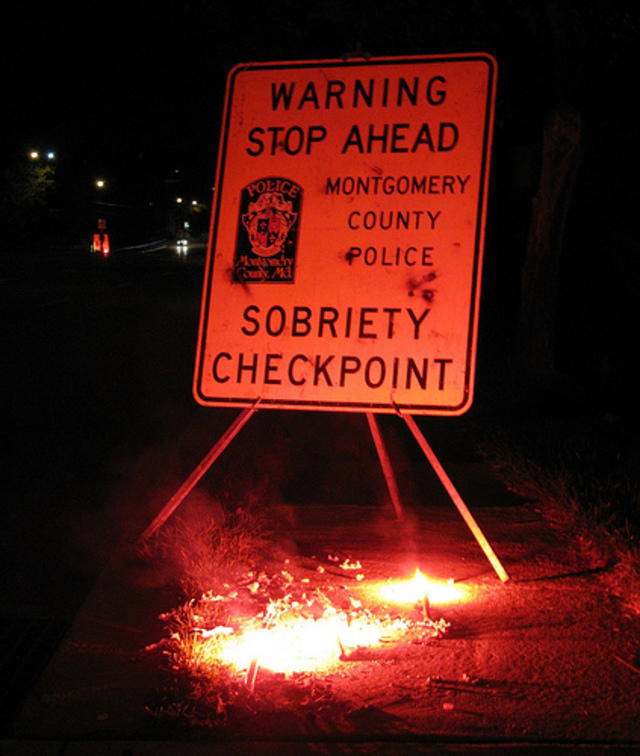
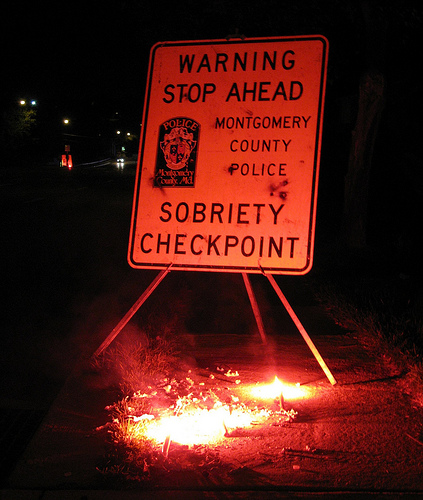
But a restaurant trade association has some advice for how cops should deal with drunk driving. The American Beverage Institute, a group of bars and restaurants focusing on the serving of what it deems “adult beverages”—aka booze—suggests that instead of roadside checkpoints, police instead rely on roving patrols.
“Sobriety checkpoints have been proven ineffective at stopping drunk drivers,” Sarah Longwell, the organization’s managing director, said in a news release. “Roadblocks target moderate drinkers instead of the root cause of today’s drunk driving problem—hard core alcohol abusers. Roving patrols can target drunk drivers as well as distracted, speeding, and drowsy drivers.”
The American Beverage Institute cites a 2009 University of Maryland study that determined that sobriety checkpoints bear no impact on drivers’ behavior or the number of alcohol-induced traffic. Additionally, a year’s worth of sobriety checkpoints in West Virginia yielded only 189 arrests for driving under the influence out of more than 130,000 cars stopped. In that same span—October 2010 to September 2011—West Virginia recorded 5,900 DUI arrests.
Instead, the restaurant group suggest just putting more officers on the streets and highways Americans will be driving to and from their Labor Day festivities. Roving officers catch 10 times as many drunk drivers as stationary checkpoints, according to court cases in multiple states cited by the American Beverage Institute.
For their part, police say they intend to use multiple practices to curb drunk driving this weekend. The Maryland State Police, under orders from Col. Marcus L. Brown, is stepping up its patrol over the holiday, though it is up to individual barracks commanders to determine the balance between mobile and stationary patrols.
“We are increasing efforts to deal with impaired drivers and aggressive drivers,” said Sgt. Marc Black, a spokesman for the Maryland State Police. “There’s nothing specific. Different barracks will do different things.”