The National Zoo wants to make visitors forget they’re actually in the middle of a steamy, noisy city. Instead, with its newest exhibit, it wants people to feel as though they’re in a Pacific Northwest riverbed, or perhaps a rocky cove in Northern California.
That’s the feel one gets walking the revamped American Trail, which opens Saturday after a five-year process that has turned a steep, unbending walkway into a gentle, winding glade full of creatures that roam the North American continent.
Planning for the $42 million renovation began in 2007, with construction getting underway in December 2009. Though renamed American Trail, the area still bore the drab effects of Beaver Valley—a name sourced from the family of wild beavers that inhabited the crevasse in the middle of the zoo. The name American Trail was adopted to better represent the diversity of specimens brought in from all corners and coasts of the North American continent.
And the facilities were dated. The sea lion tank had gone unchanged since 1976, and other habitats were also in need of upgrades or outright replacements.
The new American Trail bends and curves from the Elephant Walk at the top of the valley to its exit into the Amazonia exhibit. A stream that runs through the area has been rebuilt, one of many effects installed to improve the zoo’s resource conservation and management.
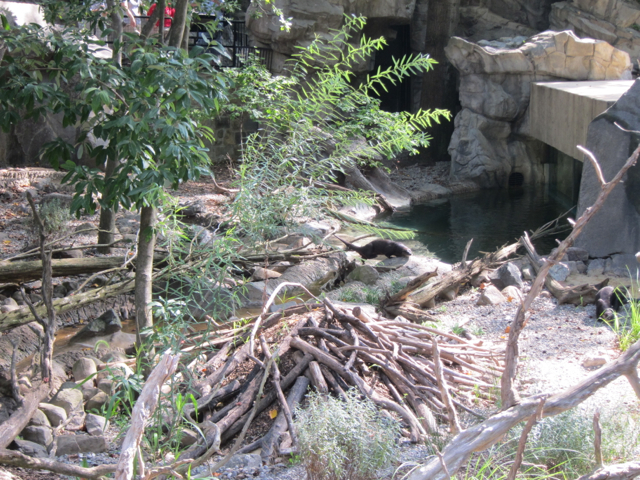
A pair of North American river otters—Nico and Conrad—live in a riverbed playpen about halfway down the trail. Showing the brothers off for visiting reporters yesterday, zoo staffers positioned treats around their habitat, waiting for the otters to snap up and gnaw at fish, hard-boiled eggs, clams and other things that otters eat.
“I want them to go out and forage,” said Malia Somerville, one of the zoo’s animal keepers. Otters, she said, are ferocious biters, typically eating an entire catch’s body. If they grab a duck, for instance, they’ll consume everything up to the bill. When they catch a fish, they chew off the tails first so their prey can’t swim away.
Still, the otters’ lives is pretty simple, Somerville said: “Eat, sleep, play.”
Further down is the biggest addition to the American Trail—new tanks for the zoo’s gray seal, Selkie, and a harem of sea lions. Selkie, who came to the zoo in 1979, idled in a shaded corner of her 125,000-gallon pool. She’s all by her lonesome right now, but will be joined by three more seals later this year.
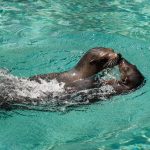
There was more activity in the sea lion pool, where four sleek pinnipeds darted back and forth across their 300,000-gallon aquarium. Edged by rocky cliffs, the pool provides visitors with views from above and below the surface, as well as a split-level viewing area that offered the best glimpses at the nimble sea lions.
And it does achieve the zoo’s desired geographic effect of transporting one from a loud and crowded city to a quiet West Coast cove.
“To me the goal is connecting people to wildlife, nature and animals,” said Chuck Fillah, the zoo’s associate director of planning who has been with the zoo for 28 years. “The goal … is that for some moment, you actually feel like you’re in the northwest, in a cove with seals and sea lions.”