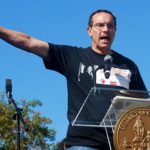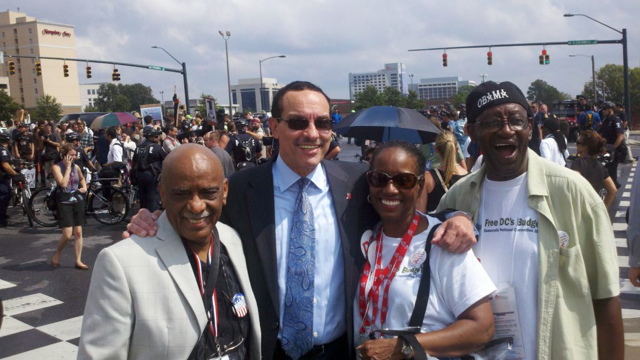
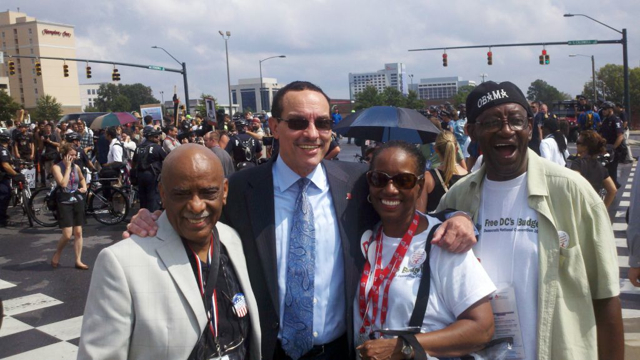
 Gray eventually got into the designated protest zone, but not in time to give his remarks. (Photo by @mattdelsignore)
Thanks to a molasses-like security perimeter at a special area designated for protests outside the Democratic National Convention, D.C. Mayor Vince Gray was unable to address a Charlotte crowd on the push for District statehood.
Convention organizers set up an area behind Time Warner Cable Arena, where the confab is being held, designated for protests on a variety of issues. Designated the “speakers’ platform,” the cordoned-off area provides city-owned equipment for groups looking to raise their issues that might not be part of the official convention program. (During presidential nominating conventions past, these areas have also been called “free speech zones.”)
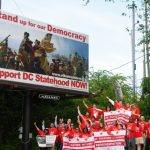
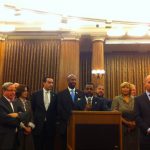
D.C. Vote was one of the groups scheduled on the speakers’ platform today, with a half-hour rally featuring many of the District’s top officials. But some scheduled speakers, including Gray, were unable to get inside the platform on time for the 2 p.m. event.
As about 40 D.C. residents were queuing up to get inside the barricaded zone, police patrolling the streets around the convention hall were locking down the vicinity and making arrests from protesters trying to remain in the area, D.C. Vote spokesman James Jones said in a phone interview. The demonstrators appeared to be affiliated with the Occupy movement and were calling for the release of Pvt. Bradley Manning, the solider who is suspected of leaking troves of diplomatic and military documents to Wikileaks.
The kerfuffle made the process of eking through the security perimeter that much more onerous. And that put D.C. Vote’s time on the platform in jeopardy. The approved protest zone is run with military-like efficiency, with each group’s time slot strictly enforced.
Jones said he was able to plea with police officers—some of whom were among the 60 Metropolitan Police Department officers dispatched to assist with convention security—to let the D.C. Vote group proceed to the platform.
“We were really lucky we got anyone at all,” Jones said. “Right when they shut down the street and sidewalk those people we were standing there.”
Most of the scheduled speakers got their chance to address the crowd, but not everyone. Statehood supporters heard from D.C. Councilmembers Vincent Orange (D-At Large), Jack Evans (D-Ward 2), Muriel Bowser (D-Ward 4), Yvette Alexander (D-Ward 7); D.C. Vote Executive Director Ilir Zherka; Shadow Representative Mike Panetta; Shadow Senator Michael Brown; and political analyst Mark Plotkin.
But Gray and Councilmember Michael A. Brown (I-At Large) were held up. Groups slotted for the speakers’ platform get just half an hour a piece, and though Gray eventually made his way through the tight security, he was too late to take the stage, Jones said.
To call security in Charlotte this week intense would be an understatement. “The police response was overwhelming,” Jones said of the response to the Occupy demonstration that froze out the entrance to the speakers’ platform. But, “the D.C. police were among the nicest among there.”
After an eight-year absence, D.C.’s push for autonomy and representation is making a return to the Democratic Party’s platform. The platform convention delegates are set to adopt tonight includes language that endorses statehood-like conditions for the District of Columbia, though it avoids using the word “statehood.” Still, after nearly a decade of omission, voting-rights advocates are very pleased to see the return of statehood-esque language.
“What we want in terms of having equal rights is in there,” Jones said. Still, though the platform backs a condition for the District of Columbia akin to statehood, the official convention program does not feature any speakers who will focus on the issue. Del. Eleanor Holmes Norton told The Washington Times it was a “bitter pill” to have to limit her speech tonight to her role as a woman in Congress rather than that as an advocate for D.C.’s lack of Congressional representation.
Jones said one of the reasons he was given for the exclusion of D.C. voting rights from the podium schedule is that the Democratic National Convention switched to a three-day format this year. That’s not a sufficient excuse in his estimation.
“As one of the biggest civil rights issues that the Democratic Party has supported for decades, even in a shorter program we should be in that program,” he said.