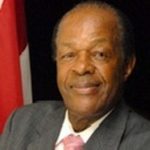
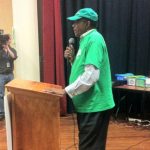
Washington City Paper had an interesting post the other day chronicling D.C. Councilmember Marion Barry’s (D-Ward 8) experiences attending Democratic conventions for the last half-century.
Barry attended his first Democratic National Convention in 1960 as a young civil rights activist when he traveled to Los Angeles for the nomination of John F. Kennedy. Loose Lips writes:
At that convention he asked that the Democrats to “provide self-government to the voteless residents in our nation’s capital,” according to an account in the book Dream City. The book details how Barry’s presentation to the party’s platform committee led to his first mention in the national press, a New York Post story that called him a “college boy.”
Barry has attended every Democratic National Convention since 1972, often eventfully. His big moment came in 1984, when he submitted the Rev. Jesse Jackson’s name into nomination. (Jackson won the D.C., South Carolina and Louisiana primaries.) Barry, then in his second term as mayor, was tapped for the prime-time speech with just a few hours to go, he told Loose Lips.
Unfortunately, it appears there is no video from the 1984 Democratic National Convention available online. But we were able to dig up Barry’s podium speech from the following convention. In 1988, when Democrats nominated Massachusetts Gov. Michael Dukakis, Barry was a member of the convention’s rules committee, not a terribly glamorous assignment, but still one that gave him a platform to beseech his fellow delegates to push for D.C. statehood.
Kathleen Vick, the New Orleans political mover who introduced members of the rules committee, gave the District high hopes when she introduced Barry, saying that D.C., “with our support, will soon be the 51st state.” The Democratic Party’s 1988 platform was the first instance of “statehood” being officially endorsed by a major party. Oh, how time flies.
Barry’s speech, which eventually reached dry, procedural rules about the presidential primary process, was vintage stuff from the mayor-for-life. He opened with his plea for statehood as the burning civil rights issue of the day, and retold the story of his upbringing in Mississippi. Unfortunately, C-SPAN videos from that era are not embeddable, so click here to watch. (Fast forward to about 33:10 for Barry.)
The years that followed the 1988 convention became the best-known chapter of Barry’s long life at the center of D.C.’s politics, and though he has attended every convention since his 1990 arrest on cocaine charges, he hasn’t been invited back to the podium. Instead, his convention attendance has been limited to gathering plenty of attention for himself working the floor and hosting parties to promote the District, sometimes to the consternation of Democratic Party officials.
But in 1988, he was a popular figure among a Democratic Party that, unlike today, overtly supported D.C. statehood.
Here’s the transcript of Barry’s remarks:
I stand here on behalf of more than 1,300 delegates and 7 million americans who supported the candidacy of the Rev. Jesse Jackson. These 7 million americans represent the quilt of America—black, yellow, brown, white and red. Those with Ph.D.’s and no degrees. Those who are employed and those who are unemployed. I also represent those Americans because of our rules are kept out and blocked out of the voting process.
I stand here representing those who despair, rather than look for hope. I also stand here representing the 650,000 residents of Washington, D.C.—where I’ve served 10 years as their mayor—who are denied full participation in the democratic process, despite the fact that we pay more taxes to the federal treasury than nine states, despite the fact that we’ve fought and died in every war, despite the fact that there is no constitutional reason why we should not be a state.
And this year, the 25th anniversary of the historic march on Washington, 23rd anniversary of the Voting Rights Act, 20 years after the assassination of Martin Luther King and Robert F. Kennedy, I call on you, my fellow Democrats and freedom-loving people, to help us get full voting rights and statehood now.
The Jackson campaign supports these fair and ethical rules. If society is to function properly, there must be rules. Likewise, for the Democratic Party to function, there must be rules. Without rules there would be anarchy and lawlessness. But the question is: What kind of rules? Do we want rules that are fair or unfair? Want rules that are unfair and disadvantages or do we want rules that give equal access, equal opportunities to everyone. It is unfair rules that kept Fannie Lou Hamer out of the 1964 Democratic Convention.
This year we worked together, as our chairman has said, to put together rules that make us a winning team, a winning strategy. Rules that make our party closer to realizing our ideals of openness and inclusion. We therefore wrestled with some difficult, and often divergent positions, adopted rules we believe will make a difference.
I stand here as a personal example of a person who’s been excluded. I was born in Mississippi, son of sharecroppers. Mother who finished the third grade and could not register to vote because she had to pay a poll tax and had to interpret the Mississippi constitution, and therefore rules are important.
We wrestled together to make sure that we eliminate loophole primaries, a rule that would make a difference. The dramatic reduction in super-delegates, a rule that would make a difference; winner take all primaries, a rule that would make a difference. With these rules, we believe we have a winning combination, therefore I urge the unanimous adoption of these rules. Victory will be ours in November. I personally need a new resident and a new president, and invite you to Washington in January for the inauguration of a Democratic president of the United States of America. Thank you.