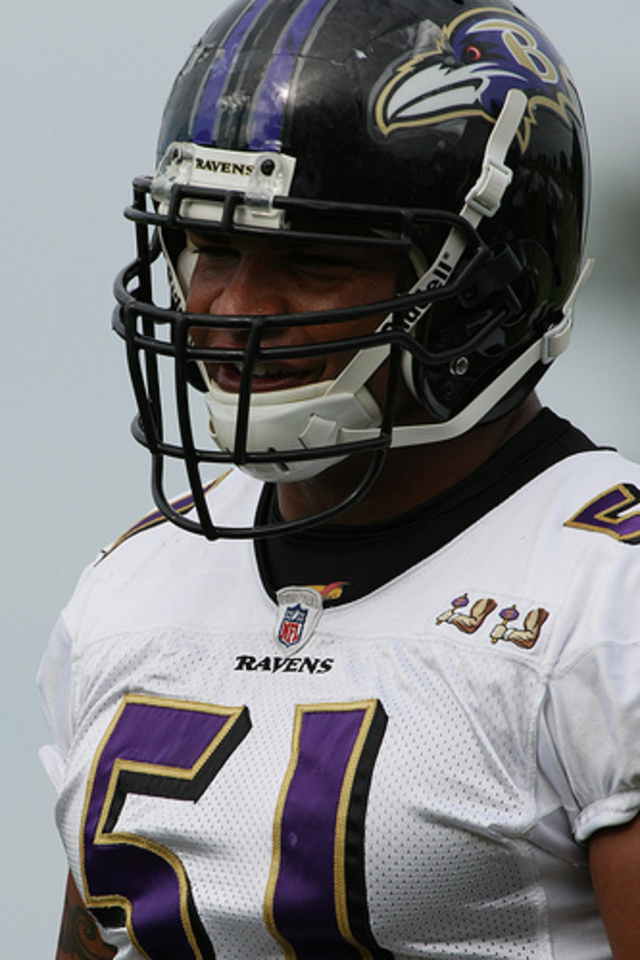
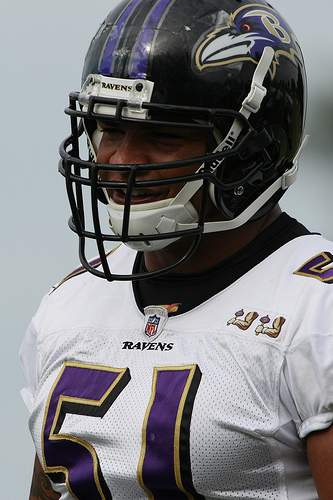
 Ayanbadejo (Photo by Keith Allison)
Brendon Ayanbadejo, the Baltimore Ravens linebacker who has been an outspoken supporter of marriage equality in Maryland, said in a radio interview yesterday that his team backs his role as an activist for equal rights.
“Our team doesn’t believe in discrimination,” he said on NPR’s All Things Considered during a segment about the acceptance of homosexuality in the NFL. Ayanbadejo gained a layer of off-field recognition last week after a Maryland state legislator who opposes the state’s legalization of same-sex marriage, called on the Ravens to silence their player. Emmett C. Burns, a Democrat who represents Baltimore County, eventually backed off, but only after Minnesota Vikings punter Chris Kluwe issued an obscenity-laden defense of Ayanbadejo on Deadspin.
Kluwe was also interviewed during the NPR segment, and said the NFL is a far more welcoming environment than the one Burns imagined it to be.
“[Guys] are happy to let people live their own lives, to let people be free, you know, free from oppression,” Kluwe said.
Ayanbadejo told All Things Considered host Melissa Block that many of his teammates support marriage equality, too, even if they are not as vocal as he is. “[They] said, hey, if two people love each other and they want to married, they should be granted the same rights as a heterosexual couple.”
And Ayanbadejo said that his teammates who believe that marriage is strictly a heterosexual coupling still believe in equivalent legal rights for same-sex couples. “But they feel like if a same-sex couple wants to have a civil union, then they agree with that,” he said.
Ayanbadejo has been a public face of Marylanders for Marriage Equality, a group that is seeking to defeat a ballot measure that would overturn the same-sex marriage law before it can take effect. It was that role that prompted Burns’ initial letter last month.
Block also asked if the NFL is ready for an openly gay active player. Both players, who are seasoned veterans, indicated it is. “If you can get your job done and you’re also a great player, the type of person that is wanted in the organization, then you’re only going to enhance the organization,” Ayanbadejo said. “It doesn’t matter what your sexual orientation is.”
Kluwe said it might be tough at first, akin to the struggles faced by Jackie Robinson or Kenny Washington, who was the first black player in the NFL to break a color barrier encouraged by Redskins owner George Preston Marshall. There would be some nasty reactions at first, likely confined to the Internet, Kluwe suggested, people would come around soon enough.
“And it’s unfortunate that people feel that way, but if we make a stand, if we make our voices heard, then, you know, we make it that much easier for whoever who decides to take that next step,” he said.
But players besides Ayanbadejo and Kluwe have made statements suggesting the NFL would welcome an openly gay player. In May, Robert Griffin III said he would have no problem with a gay teammate. “As long as they’re playing good football and contributing to the team, I don’t have nothing to do with that,” he said.
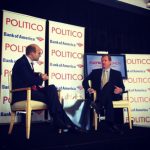
On Wednesday, NFL Commissioner Roger Goodell was asked at a lunch event to weigh in on the flap between Ayanbadejo and Burns. While he avoided giving his own thoughts on same-sex marriage or the notion of an openly gay player, he was supportive of players speaking their minds on non-football matters.
“They speak as individuals and that’s an important part of democracy,” Goodell said.