Martin Austermuhle
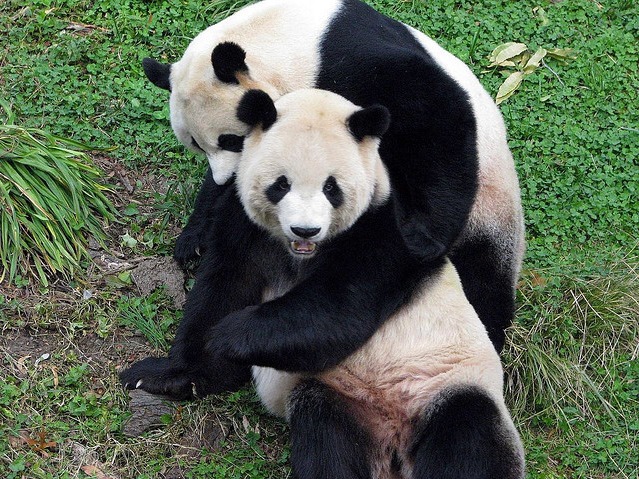 Tian Tian and Mei Xiang. Photo by RoxandaBear
When the National Zoo’s female giant panda Mei Xiang was artificially inseminated in April, scientists had a number of samples of panda semen to choose from. But they opted for an auspicious 2005 sample—it was the same one from male panda Tian Tian that had produced Mei Xiang’s last panda cub, Tai Shan.
That wasn’t coincidence, nor were zoo scientists simply looking for a little reproductive luck—the 2005 sample, which officials referred to as “vintage sperm,” was simply the best the zoo had on hand. According to Dr. Pierre Comizzoli, who jokingly referred to himself as Mei Xiang’s “personal gynecologist” at a press conference yesterday (he’s formally a biologist and reproductive physiologist at the Smithsonian’s Conservation Biology Institute), the sample that has birthed two panda cubs so far was better than other samples taken on a yearly basis from Tian Tian.
“That sample, in 2005, was really good because a majority, more than 90 percent of the sperm cells, were moving and the concentration was really high, it was over 1 billion sperm per milliliter. So, it was a really good sample and that’s why we decided to freeze it and use it later on,” he explained to us today.
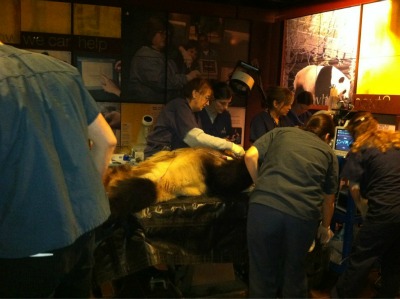 Mei Xiang as she was being artificially inseminated in April. Photo by @NationalZoo
Comizzoli, who has been at the zoo for almost 11 years and was on the team that produced Tai Shan, said that Mei Xiang also did her part—with timing. While in past years she entered her breeding season in January—”pretty unusual,” he remarked—this year it landed in a sweet spot for conception.
“This year, she was back to a normal situation, because usually pandas have their breeding season between March and May. This year, she was in estrus at the end of April, right in the middle of the window of opportunity. It was already a good sign, and we think that it helped, at least in comparison to the last years,” he said.
Put together, Tian Tian’s frozen sperm and Mei Xiang’s well-timed estrus produced the National Zoo’s first cub since Tai Shan—and even as zoo officials warned that Mei Xiang’s chances stood at a mere 10 percent.
Comizzoli admits that Mei Xiang has been tougher to get pregnant than some of her fellow giant pandas in and out of the U.S.—San Diego’s Bai Yun has produced six cubs since 1996, for one—but that the variation is normal and helps scientists better understand how pandas get pregnant.
“There is a lot of variation between individuals. It’s like humans. You have some women that have no problems having babies, and there are others who have a hard time having babies and do not necessarily concieve immediately,” he said. “The knowledge is accumulated little by little.”
“[Pandas] have this very unique physiology where there is no indicator of pregancy like in other mammals, where usually the progesterone is the indicator. But for the panda, progesterone is not an indicator of the pregnancy. It’s really important here to understand better and to make sure we going to produce cubs, because we need the cubs [for research],” he said.
The zoo receives $250,000 a year from the federal government for panda care, and an additional $250,000 is raised privately for conservation science research. Some $550,000 a year is paid to the Chinese government as part of the agreement under which the zoo gets to keep Mei Xiang and Tian Tian. Last year, local philanthropist David Rubenstein gave the zoo $4.5 million for panda reproduction research, and earlier this month the Ford Motor Corporation gave $400,000 towards research and upgrading the popular Panda Cam network.
Zoo officials said yesterday that while they will skip next year’s breeding season so that Mei Xiang can care for the new cub, they could try again in 2014. And yes, there’s some of the 2005 sperm sample left to work with.