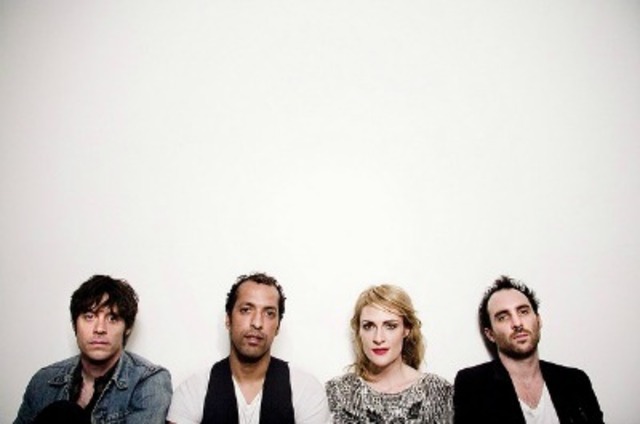
 Photo from Metric’s website
The Canadian new wave band Metric cycles perpetually between intimacy and distance, often several times within the confines of a four-minute song.
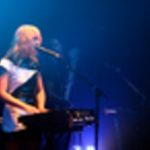
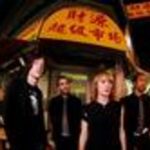
In a 105-minute headlining set Friday night at the Music Center at Strathmore—the region’s best-sounding room—frontwoman Emily Haines and her three comrades at first seemed to be performing behind an invisible wall, staring through the eager crowd mere feet in front of them. They weren’t disengaged; just focused: by the time Haines said, “Hello, D.C.!”, they’d already finished five or their chilly but propulsive tunes.
The LED wall they’d brought along seemed intended for venues less cozy than this one; it blinked on and off, in geometric patterns in time to the music. They’re the first act I’ve ever seen show up at the stately Strathmore—which tends to book more solo or duo acoustic performances than noisy rock bands—with a smoke machine.
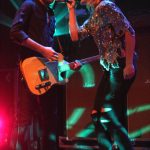
Haines was the focal point by a bigger margin than the typical lead vocalist advantage, high-kneeing around the stage as though on an invisible unicycle, her toned legs impossible not to notice in her short skirt. Her sinewy voice rang clear and strong, seemingly unaided by the electronic processing that rendered guitarist James Shaw’s backing vocal on the dystopian march “Youth Without Youth” and other songs ghostly and forbidding. Shaw’s guitar was more prominent in the mix than on the group’s records, but the vocals and synth-y textures still dominated, making it hard to tell to what extend precorded samples fattened up the sound.
Metric’s fifth album, Synthetica, got a big push, contributing the first four songs of the set, and seven of its 18 overall. The group opened with the album’s first three tracks in sequence—borrrrrr-innnnnnnng!—before branching off on a fresh path. The five cuts from their 2009 breakthrough Fantasies got the most boisterous response from a crowd that skewed mid-20s, well below the Strathmore norm. That record’s big opener, “Help I’m Alive” had a large, mostly female portion of the audience pogoing and pounding their fists to its “beating like a hammer refrain.” At least one girl expended so much energy jumping up and down that I spotted her dozing in her chair a few songs later.
Haines spoke only a few times, once to shower praise the 9:30 Club and its staff. (The show was organized by I.M.P., which runs the 9:30.) There’s a little of U2 in this band—not just the sweeping choruses, but in the way three commanding but mostly stoic players surround a flamboyant, charismatic singer. After a raucous “Stadium Love” brought the set proper to a close, giant LED numbers counted down a two-minute interval before the band returned.
Openers Half Moon Run joined Metric for a tender cover of The Velvet Underground’s indestructable ballad “Pale Blue Eyes,” but left Haines to sing “The Wanderlust”—the Synthetica track that Lou Reed himself actually sings on, on the record—by herself. For the final number, Haines and Shaw performed an warm acoustic version of “Gimme Sympathy,” with their rhythm section, Joshua Winstead and Joules Scott Key, clapped along. That’s the one that asks, “Who would rather be, the Beatles or the Rolling Stones?” before imploring, “Come on, Baby, play me something / Like ‘Here Comes the Sun’.” I always felt like that lyric should sub in the the title of a Stones song on alternate choruses—“Under My Thumb,” has the right number of syllables. It appears on the Scott Pilgrim vs. the World movie soundtrack album along with Metric’s own “Black Sheep.”
They played that one, too. First song of the encore. By then they’d settled on intimacy, at least until the end of the night.