Martin Austermuhle
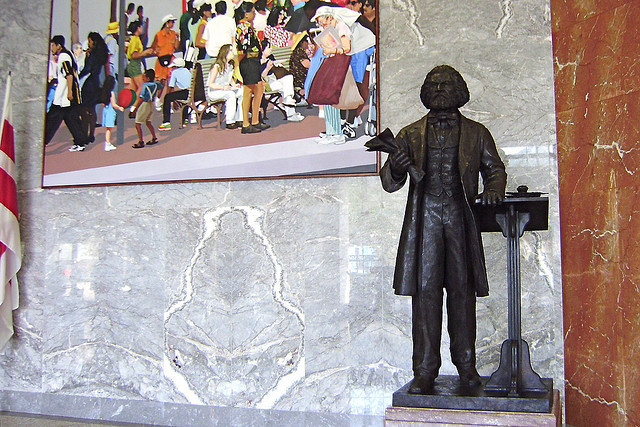 Photo by lreed76
Written by John Muller
Were Frederick Douglass alive today he would not sit back quietly and hold his tongue.
President Obama’s signing into law of House Resolution 6336, giving the Joint Committee on the Library two years to move the bronze statue of Douglass now in the lobby of One Judiciary Square to the United States Capitol’s Emancipation Hall, would not impress the Lion of Anacostia.
During his remarkable life Douglass championed many public and private causes—the abolition of slavery, women’s rights, temperance, classical and technical education for freedmen and their sons and daughters, and Irish Independence, to name a few—but his most enduring advocacy on behalf of D.C. and Washingtonians is all but forgotten.
In the recent burst of press releases and stories about the statue’s move, Douglass’ national legacy has been invoked, but not his local one. Nowhere will you find mention of Douglass’ activism with the Citizens’ District Suffrage Petition Association, a late 19th-century organization whose work remains unfulfilled.
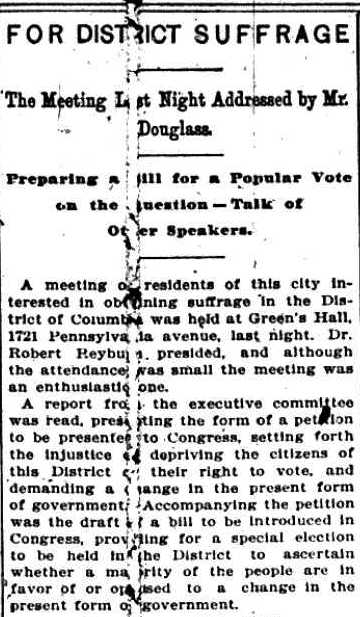 An Evening Star article from 1895
Less than a month before his sudden death on the evening of February 20, 1895 at Cedar Hill, his southern Victorian mansion and sprawling estate in Anacostia (now a National Park Service site), Douglass was part of a small group that attended a meeting of the Citizens’ District Suffrage Petition Association at Green’s Hall on Pennsylvania Avenue. After the executive committee read its report and official business closed, Douglass spoke first.
“Neither the frowns nor the smiles of the present government could deter him from expressing his partisanship in the cause of liberty,” wrote a correspondent for the Evening Star covering the event. Douglass reportedly asked, “[W]hat have the people of the District done that they should be excluded from the privileges of the ballot box? Where, when and how did they incur the penalty of taxation without representation?”
Throughout his life Douglass was a friend of the capital city. More than thirty years before he first visited Washington during the Civil War, Douglass was an enslaved adolescent in Jacksonian Baltimore; he first felt the powerful allure of the ideals of Washington when he read in a February 1833 newspaper of a petition in Congress sponsored by former President John Quincy Adams to abolish the slave trade in Washington “Thenceforth he knew that he was not without friends,” wrote 19th century Douglass biographer Frederic May Holland.
Following the lead of his three sons, who by the late 1860s had all settled in Washington, Douglass split time between Rochester, N.Y. and Washington beginning in 1870 to run The New Era, the first newspaper of national consequence for African Americans. In April 1871 Douglass had a unique experience with the American experiment of democracy that is Washington, D.C. After narrowly losing the Republican nomination for the Territorial Government’s newly created position of Non-Voting Delegate, Douglass was appointed by President Ulysses S. Grant to serve on the District’s Legislative Council. In 1872, Douglass purchased his first D.C. home on Capitol Hill.
Douglas’ impact on Washington from his support of a nascent Howard University to his four years as a U.S. Marshal to advocating for District suffrage has escaped the attention of biographers and faded from the public’s consciousness. His advocacy for “disenfranchised” citizens of the District of Columbia was no secret during his lifetime.
Writing in an 1892 update to his autobiography Douglass said of city residents:
The District of Columbia is the one spot where there is no government for the people, of the people, and by the people. Its citizens submit to rulers whom they have had no choice in selecting. They obey laws which they had no voice in making. They have a [sic] plenty of taxation, but no representation. In the great questions of politics in the country they can march with neither army, but are relegated to the position of neuters.
According to Ka’Mal McClarin, curator at the Frederick Douglass National Historic Site in Anacostia, Douglass corresponded with members of Congress on the issue of District suffrage.
On the evening of January 21, 1895 at Green’s Hall Douglass acknowledged an often used objection to District enfranchisement, “That colored men will have a vote.” He also spoke of “the contradictory spectacle presented to the ministers of foreign nations by the presence of an unrepresentative form of government at the capital of the most progressive republic on the globe.”
To honor and celebrate Frederick Douglass with a statue in the Capitol’s Emancipation Hall is fit and proper. To knowingly or unknowingly obscure his most personal legacy of activism and contributions to Washington, D.C. is not, statue or no statue.
Muller is the author of the forthcoming Frederick Douglass in Washington, D.C.: The Lion of Anacostia, which will be published October 2, 2012 by The History Press.