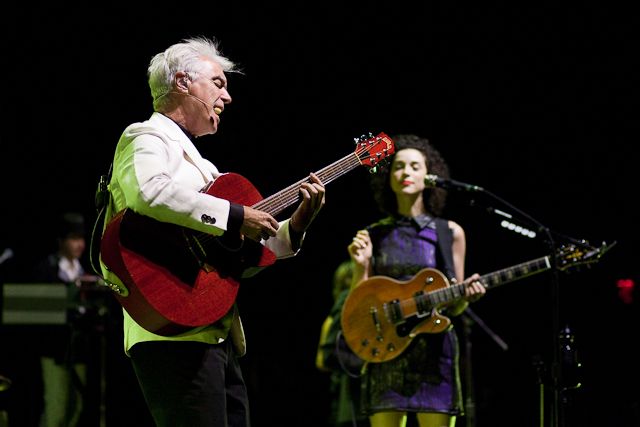
David Byrne and St. Vincent put on a dazzling display of songcraft and showmanship at The Music Center at Strathmore on Sunday night, enthralling a rapt audience with a memorable performance that seamlessly blended the distinctive talents and idiosyncracies of the year’s most highly-touted musical collaborators.
Despite the steep ticket prices (orchestra seats were $125), Strathmore’s 1,976-seat concert hall was nearly full by the time the 60-year-old art-pop legend and the 30-year-old indie star took the stage with their ten-piece touring band. Clarion riffs blared from the horn section, announcing the set-opening “Who,” the quirkily cadent lead single from the pair’s recently-issued LP, Love This Giant. Strumming an acoustic guitar, Byrne cut loose his unmistakable vocal warble before St. Vincent — a.k.a. Annie Clark — joined in with a nimble falsetto, adding some skronky melodies from her electric guitar. On the energetic “Weekend in the Dust,” it was Clark’s turn to take the lead, with Byrne adding subtle backing vocals on his headset mic while joining the horn players in the first of the evening’s many choreographed stage routines, which ranged from amusing, to impressive, to at times distracting.
Along with all but one of the twelve tracks on Love This Giant, Byrne and Clark also played a selection of songs from their own oeuvres, and these often got the most spirited response from the audience. Byrne, of course, remains best known as the frontman for Talking Heads, and he led his cohorts through a few of the celebrated new-wave band’s popular favorites, starting with the jaunty “This Must Be the Place (Naïve Melody),” which he sang while engaging in a series of on-stage calisthenics so spectacularly awkward that they actually became mesmerizing. On his catchy 2001 solo track, “Like Humans Do,” Byrne traded vocal melodies and dance moves with Clark, the pair grinning broadly as they shimmied about the stage, and “Strange Overtones” (a 2008 collaboration with Brian Eno) provided a sparkling early-set highlight.
Playing with a bigger band than she’s toured with since her days with The Polyphonic Spree and Sufjan Stevens, Clark unleashed some souped-up new arrangements of some of the best songs from her already-impressive solo catalog. “Marrow,” in particular, was more explosive than ever, the recorded version’s processed horn lines paling in comparison to the brassy punch of eight live horns. Late in the set, Clark showcased her impressive vocal range and formidable guitar chops during the strobe-lit crescendos of “Northern Lights,” at the end of which Byrne joined her on a spastic theremin jam that was heartily cheered on by the crowd.
Indeed, the artists’ individual material may have stolen the show to some extent, but the new, collaborative songs more than held their own, with offerings like “The One Who Broke Your Heart” sounding more robust and dynamic than on record, bolstered by truly sterling work all night long from the backing musicians, and aided by Strathmore’s top-notch acoustics. That said, Love This Giant was nowhere to be heard when Byrne and Clark pulled out all the stops at the end of the show. The first encore kicked off with St. Vincent’s incandescent 2011 single “Cruel” before the Talking Heads classic “Burning Down the House” pretty much did just that, its infectiously jittery rhythms getting the crowd roaring out of their seats and dancing in the aisles.
After Byrne thanked his family and friends who were in attendance (he has roots in the Baltimore area), a second encore began with St. Vincent’s ethereal ballad, “The Party,” the musicians waltzing around in pairs as they played, which, along with the spectral shadows cast behind them, made for one of the evening’s more evocative visuals. Finally, the show culminated in irresistibly rousing fashion, as Byrne led everyone through Talking Heads’ “Road to Nowhere,” the existential connotations of the song’s title belying its sublimely joyous sound. The titular metaphor was literalized in a final bit of stage antics, with Clark lining up with the backing band in an instrumental conga line that made aimless peregrinations all over the stage around Byrne, who eventually got swept up in the parade, marching offstage with his tourmates to a standing ovation.