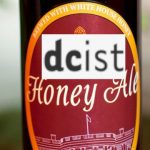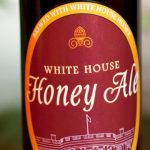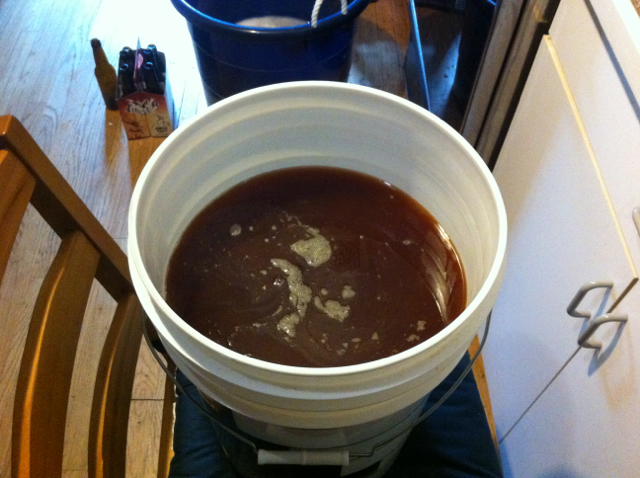
After three weeks of brewing, the DCist Honey Ale entered its next phase yesterday when we finally moved the fresh beer from the plastic drum where it had been fermenting to bottles. And we also got our first taste of the stuff. It’s not quite finished yet, as it needs to carbonate for a couple weeks, but we can report that after following the White House’s beer recipe released last month, we are in possession of a medium-brown ale that offers a smooth, floral taste without being overpowered by the pound of honey called for by the formula.
Our brewmaster, John Lutz, creator of the White House petition that helped prompt the recipe’s publication, let Martin Austermuhle and me into his house yesterday, where he brought out the drum in which the ale had been sitting since the brewing on September 21.
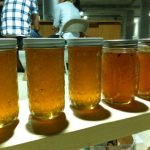
Three weeks was ample time for the yeast to eat through the sugars in the pound of D.C.-sourced honey we obtained at American University. Though the inside of the drum’s lid was covered in a thick layer of gunk—remnants of yeast—the beer was a sweet, warm amber.
The first step was to add one last solution of boiled water mixed with corn sugar, to give the last bits of yeast something to feed on while bottled up. After adding the sugar water, it was time to siphon the beer into a clean drum with a built-in spigot.
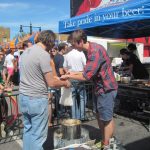
Finally, bottling time. Martin sanitized the bottles—collected, no doubt, from many beers past—in a soapy wash, Lutz regulated the spigot and I worked the clamping device to cap each bottle. In total, the brew yielded 49 bottles, mostly 12-ounce containers with a few larger pours to boot.
Now, we wait another two weeks while the final traces of sugar are absorbed and the beer reaches completion. Plenty of time to beseech the White House to accept our invitation to a beer swap and taste test. After all, what good is brewing to their specifications if we can’t share with the original source?
With the last bottles filled, there was just enough beer left in the tank for the three of us to drink a sample. Though the quaff was warm and flat, it was unmistakably beery, with a sweet, but not sugary, bouquet and a pleasantly aromatic finish. We can confirm that this beer will be great.