Martin Austermuhle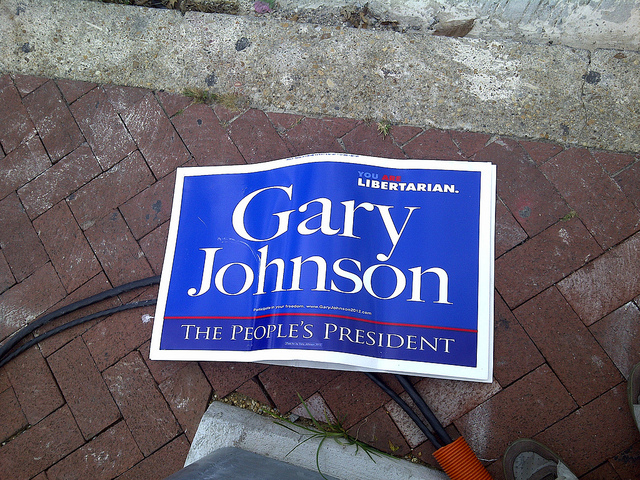
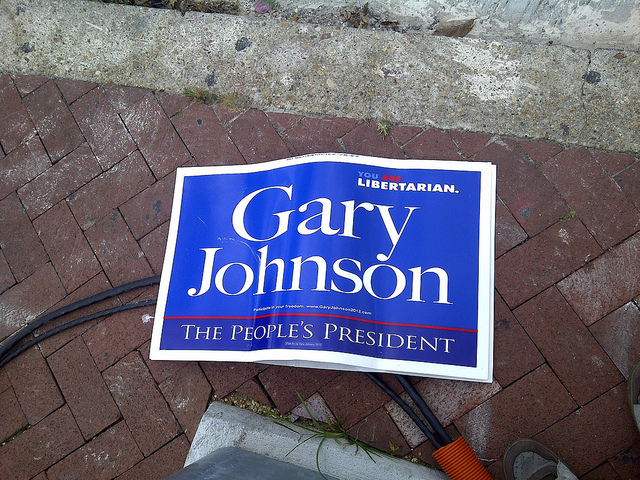 Photo by Pain Perdu Pumpkin Retrouvée
Bruce Majors doesn’t try to pretend that he’s going to beat D.C. Del. Eleanor Holmes Norton. That’s not really even the point, he concedes. The 53-year-old real estate agent—and author of the infamous Tea Party Guide to D.C.—will be the sole Libertarian contesting a local race in November, and despite his own admission of likely defeat, sees his attempt as serving a higher purpose.
At a happy hour yesterday in Dupont Circle for Libertarian Party presidential candidate Gary Johnson, Majors told us that he’s looking to secure major-party status for Libertarians in D.C. The status, which takes 7,500 votes to achieve, would allow local Libertarians to have a primary in 2014 and put them in a category alongside the Democrats, Republicans, and Statehood Greens.
“I have a specific practical goal of getting a certain amount of votes,” Majors told us. He admits he doesn’t hide his intentions when speaking to voters: “I usually tell people that at some point because I don’t want people to think I’m completely deranged,” he said, noting that Norton has consistently defeated challengers since first taking the seat in 1991.
Majors said that the broader goal is to open up the city’s political party system to more competition. “It’s also because we have this really corrupt political class in D.C. I think there’s actually a real need for there to be another political party in D.C., and one that’s particularly critical of government,” he said.
Getting 7,500 votes might not sound like a lot, especially in a city that has over 450,000 registered voters. But it has been a challenge for Libertarians over the last 12 years. The closest the party got was in 2000, when At-Large contender Matthew Mercurio got 5,771 votes and another Libertarian challenger to Norton, Rob Kampia, got 4,594.
Will having Gary Johnson, the former governor of New Mexico, on the D.C. ballot help? His advisers certainly think so, saying they hope to draw in enough votes from gentrifying neighborhoods to push Johnson into second place in the presidential race in D.C.
In an interview yesterday, Johnson said he had but one message for D.C. voters: he’d be the best of all the presidential candidates to tackle the nation’s fiscal challenges. “We’re really in deep trouble as a country. We have to balance the budget now, or we’ll find ourselves in a monetary collapse. We can’t escape the mathematics of continuing to borrow and print money to the tune of 43 cents out of every dollar we’re spending,” he said.
He also said that he would work to end the war on drugs, and even hinted that he’d be for lifting the restrictions on building heights in D.C. “Maybe that should be a local issue,” he told us. As for D.C. voting rights, he’s for it. “I know that the issues are complex surrounding the Constitution and making D.C. a state, but I’m in the camp that there should be representation.”
Given that D.C. will go heavily for Obama and Norton, is there space for the Libertarians to peel off some voters by convincing them that they can vote their preference and know that Obama and Norton will both likely win the city’s overall vote? Maybe, and Majors would be more likely to benefit from that than Johnson. According to Majors, D.C. voters were hesitant to sign petitions to get Johnson on the ballot because of fears that he might draw votes from Obama and Romney. (The Libertarian Party filed suit in D.C. over regulations that they say make it hard for minor party candidates to get on the ballot.)
Moreover, there’s history to consider—the last two Libertarian Party presidential candidates that got on the ballot in D.C. only managed 669 and 502 votes, respectively.