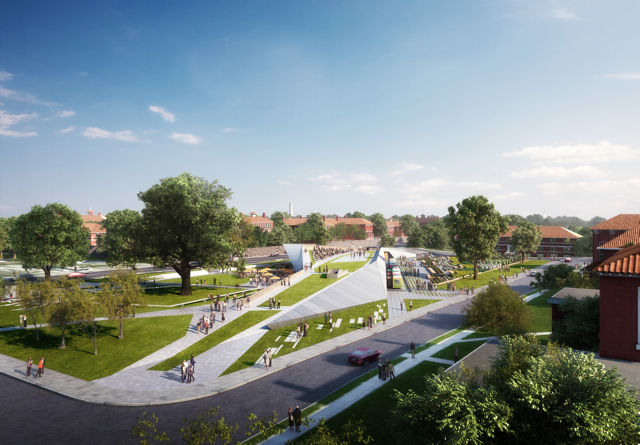
 A rendering of the Gateway Pavilion at St. Elizabeths. (Davis Brody Bond)
The District’s dream of turning St. Elizabeths Hospital’s east campus into a modern complex of government agencies and technology firms in the heart of Congress Heights is still several years away from completion, but the look for the next phase of the historic site was revealed over the weekend.
The Gateway Pavilion, spread over a two-acre plot of the campus, will open next year with the aim of laying the groundwork for turning the old hospital into a burgeoning hub of commercial activity. The architecture firm Davis Brody Bond submitted the winning design or the $5 million pavilion, Mayor Vince Gray announced Saturday.
When it opens next year, the pavilion will serve as a temporary, but extensive, entrée into the future of St. Elizabeths with a network of green spaces, walkways and what D.C. officials hope will be plentiful dining options.
“We’re trying to continue to add value to this development,” Ethan Warsh, a project manager in the office of the Deputy Mayor for Planning and Economic Development, says in a phone interview. “It needed to be something remarkably iconic, something that would continue to brand the site, bring people to the site, fold it into the community.”
Davis Brody Bond’s design suggests terraced lawns, sloping paths and plenty of space for food trucks and kiosks to set up shop for the two years that the Gateway Pavilion will anchor St. Elizabeths. Walsh says the goal is to make it an much an asset for the Congress Heights community as it is envisioned to be for the growing ranks of federal employees whose offices will move to the hospital campus. The U.S. Coast Guard is set to move the first of its employees to the St. Elizabeths west campus in May 2013.
One of the tricks of the design, though, was coming up with a plan that works for a plot of land that will be mostly disconnected from D.C.’s electric and water grids. St. Elizabeths was constructed separately from the District’s utilities, and while the campus is reconnected to the city, the pavilion will need to be configured to function on its own.
Peter Cook, a principal in Davis Brody Bond’s Washington office, says the pavilion will utilize cisterns to clean and recycle storm and drain water in order to operate on-site rest facilities, and possibly to cultivate a series of gardens. Cook is also looking into installing a grid of photovoltaic panels to provide electricity.
“A variety of different ways to make sure this can operate independent of the fact that there are little utilites,” he says.
The overarching idea, Cook says, was to balance “iconic architecture” with a national historic site, “not just another box.”
For the District, community utility is just as important as raw functionality. “The task wasn’t just about creating a structure, but about creating a place,” Warsh says.