Martin Austermuhle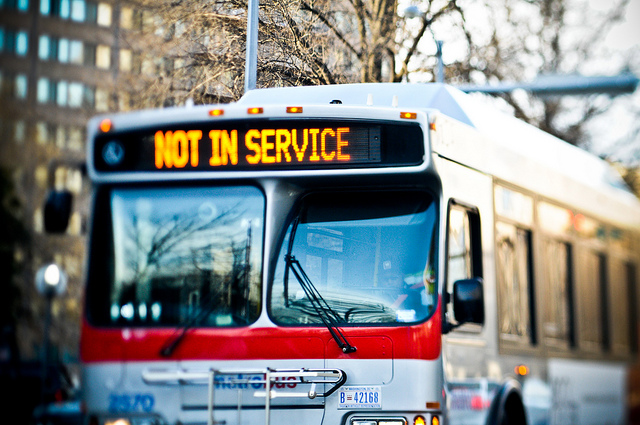
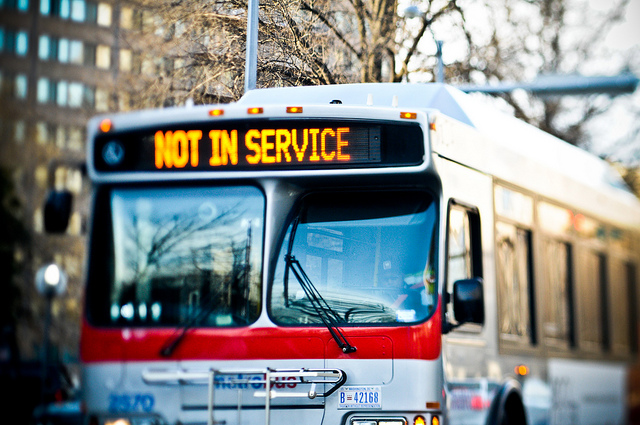 Photo by Chris Rief
While Metro will often propose changes to bus routes due to low ridership or to make getting from point A to point B more efficient, the transit agency is advising that two Southeast D.C. bus lines avoid one segment of their route because of a very different reason—rock-throwing.
 The segment of the W6/W8 bus route that would be discontinued after 8 p.m.
As part of a broader slate of proposed changes to a number of bus routes, Metro wants to cut a segment of the routes run by the W6 and W8 buses because of multiple incidents in which buses have been pelted with rocks.
According to the proposal, after 8 p.m. the buses —which start at the Anacostia Metro station and drive a loop through Ward 8—would stop turning into two residential neighborhoods off of Stanton Road where the incidents have occurred. “Remove service from areas that experience repeated incidents of physical damage to buses from rock throwing, which endangers bus operators and customers,” the proposal explains.
According to Metro spokesman Dan Stessel, the rock-throwing has happened often enough to merit the change. “We don’t have exact statistics, but it would be safe to say that rock-throwing incidents occur several times a week, and sometimes on a daily basis. These incidents pose a safety risk to our customers, employees and vehicles,” he said.
The problem isn’t new, it seems. In 2005, the Post reported on a rock-throwing that sent a W4 Metrobus driver to the hospital:
A Metrobus driver was injured last night when youths threw a brick into the windshield of his moving bus in Southeast Washington, a Metro spokesman said.
After stopping his W4 bus, the driver, who was not identified, was taken to a hospital where glass fragments were washed from his eyes, said Metro spokesman Steven Taubenkibel. He said Metro Transit Police are looking for three youths in connection with the 6:24 p.m. incident on Southern Avenue near Easy Place in the Benning Heights area.
None of the dozen passengers on the northbound bus was reported injured. Authorities have identified rock throwing at buses as a significant problem in parts of the region.
In 2008, the Metrobus drivers union posted an image of a man that threw a baseball-sized rock at a driver, leaving him with stitches.
Stessel said that similar incidents in the past have resulted in rerouting, and that other considerations were factored into the proposal. “I would note also that there isn’t a lot of ridership on this segment, and that operating into a cul-du-sac and back is not a standard operating practice. We do it in a few places, but would prefer not to as a basic service design principal,” he said.
The proposed route changes will be discussed at public hearings scheduled for October 22-30.