Martin Austermuhle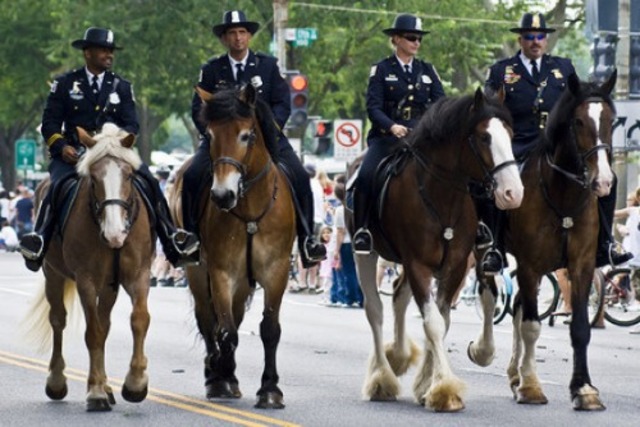
 Photo courtesy of DCMetroPoliceCollector.com
During yesterday’s debate on foreign policy, President Obama scored what may have been the zinger of the night when he mocked Republican challenger Mitt Romney for thinking that when it comes to military hardware, quality matters more than quantity. “Well, Governor, we also have fewer horses and bayonets, because the nature of our military’s changed,” Obama quipped.
Sure, but how about the nature of policing the capital? Officers are more and more likely to be seen on bikes, motorcycles, cars, and even Segways, but that doesn’t mean that local police forces have completely rid themselves of the horses that used to be part and parcel of maintaining order in D.C.
In fact, the Metropolitan Police Department went in exactly the opposite direction in 2001, when Police Chief Charles Ramsey reinstated the Horse Mounted Division that had been disbanded some 70 years earlier. (Check out some great historical pictures here.) Wrote the Post’s Petula Dvorak of Ramsey’s decision:
Gainer said he expects the mounted police to be a welcome sight in many neighborhoods as they patrol open-air drug markets and other crime hot spots. He hopes to increase the number of horse-mounted officers to between six and 12 by fall.
“You could have a police officer standing on a corner all day, and no one notices,” Gainer said last month during a D.C. Council oversight hearing. “But if that officer was on a horse, the officer would stand out, and passing residents would stop and talk with the officer.”
Scully agreed, noting that when he and Poskus took their borrowed Park Police horses to drug-troubled areas of Northwest, people on the street were very receptive to the horses.
“When we went up there in our marked cars, they wouldn’t even talk to you,” said Scully, an 11-year veteran of the department. “I went up there on a horse, and they were flocking to us.”
As of 2010, the division consisted of seven officers and four horses: Sampson and Thunder, both Clydesdales; Seamus, a Percheron/Belgian; and Rosie, a Belgian/Quarter Horse.
MPD’s mounted division is small, at least relative to the U.S. Park Police’s division, which was created in 1934 to allow for easier patrolling of Rock Creek Park and has since extended to New York and San Francisco. According to the Park Police’s website, horses serve a number of purposes:
Experts say a horse in a crowd is worth fifteen or twenty foot patrol officers. People look up to the officer on a horse and it’s a powerful image. If a crowd starts to get out of hand, and the officer tells someone to stand back or move away, the individuals are less likely to resist or talk back to the horse mounted officer. A lone officer on foot may have to resort to force to achieve the same result. The height advantage also work well in routine patrol because it lets the officer see pickpockets, car busters and other criminals that an officer on foot would miss in a crowd. The animal’s size works well in another way. People, who need a police officer or simply want to feel safe, can see an officer horseback a block away. The “clip-clop” of the approaching horse hooves, signals to the citizens that help is on the way.
Horses are also used by the Maryland-National Capital Park Police, and after Ramsey decamped for Philadelphia he even reinstated that department’s mounted unit. There’s even a local non-profit that works to support mounted divisions—it’s called the HOOFS Fund, of course.
Coincidentally, the Washington International Horse Show kicks off today, on on Thursday morning a number of the city’s local police horses will be on hand for the 2012 Breakfast with the Mounted Police Horses. Yes, the horses will be eating too—hay and apples. On Friday, the U.S. Army’s Caisson Platoon military horses will be at the show for Military Night.
Obama isn’t totally wrong, though—there are fewer horses out there. In 2005, for one, Congress discontinued the U.S. Capitol Police’s mounted unit.
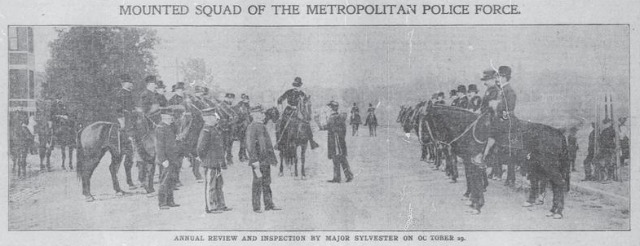 D.C.’s mounted police in 1903. Photo courtesy of DCMetroPoliceCollector.com