Martin Austermuhle
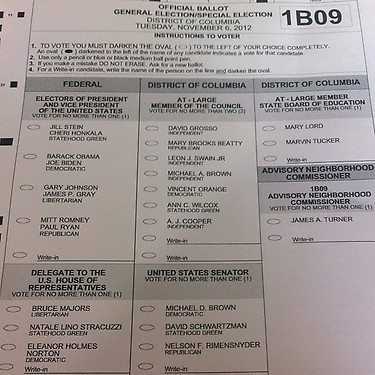 In Tuesday’s D.C. election, 244,770 voters cast ballots for everything from president to school board. Unlike most of the contests, though, the race for the At-Large seats on the D.C. Council allowed voters to choose two candidates, instead of the usual one. Many of them didn’t.
On Tuesday there were 328,659 votes cast for the At-Large seats, but there were also 160,655 ballots that came in as “under-votes”—when a voter either chose fewer options than they could or when their votes weren’t read properly. In 2008, the same thing happened—361,442 votes were cast for the At-Large race, but there were also 168,469 under-votes. Four years before that was no exception, when there were 303,047 votes cast and 151,363 under-votes in the At-Large race.
Does this mean that half of the city’s voters aren’t using both of their votes? Not necessarily—if one voter chose no candidates in the At-Large race, for example, it would come up as two under-votes. Still, the numbers are evidence that many voters aren’t voting to their full potential. In many precincts the under-votes were half the number of votes cast in the At-Large race, while in some, such as Precinct 103 in Ward 7, the numbers were much higher—2,679 votes were cast for At-Large candidates, and there were 1,949 under-votes.
The explanations for under-voting are many. Some voters do it on purpose, for one. Called “bullet” voting, the voter chooses only their top candidate so as to not dilute their chances of winning. In the At-Large contest, we’ve heard from voters that only chose eventual winner David Grosso because they thought he had a chance and didn’t want to cast ballots for either incumbent. GOP challenger Mary Brooks Beatty followed party tradition and asked her supporters to do the same and vote only for her.
In other cases, ballot design and education can play a role—voters may not realize they can pick two, or they simply may not know enough about the contenders to want to hazard a guess.
The latter argument is bolstered when the At-Large race is compared against races for the D.C. State Board of Education, where voters may not have heard much about who’s running or even what the board does. In the race for an At-Large spot on the board—where only one candidate was selected—180,000 votes were cast and over 58,000 ballots were returned with no candidate chosen. The same generally applied for ward-based education board seats, and even many Advisory Neighborhood Commission seats. By comparison, there were only 552 under-votes in the presidential contest, and of the 120,000 votes for mayor in 2006, only 1,681 under-votes were reported.
We also heard from voters that simply forgot to cast a second vote because they felt pressured by long lines and hectic polling places.
Does this matter? It depends who you ask. Some have argued that voters are effectively disenfranchising themselves, while others say that protest votes—and even submitting blank ballots—have a long and rich tradition in many democracies. But in the cases where a voter only casts one ballot because they didn’t know otherwise, it points to a need for much more thorough voter outreach and education.