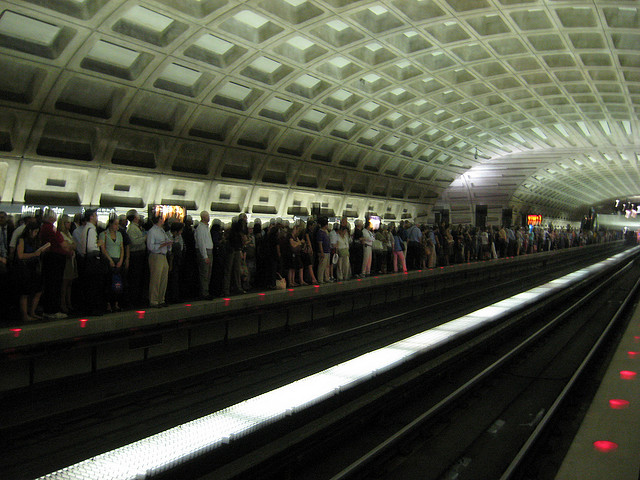
 Photo by Tricia G.
About 90 percent of residents in the Washington region have ready access to public transportation that can ferry them to and from work in 90 minutes or less, according to a new study by the Brookings Institution. But those neighborhoods with the most efficient transit are also the most expensive, keeping many low- and moderate-income workers more distant from their workplaces.
“Low and mid skill residents should not be priced out of neighborhoods with strong transit access,” Martha Ross, a Brookings fellow and one of the report’s authors, said in a press release. “Planning and investments for transit and housing should go hand in hand.”
The report, “Connecting to Opportunity: Access to Jobs via Transit in the Washington, D.C. Region,” ranks neighborhoods throughout the greater D.C. area according to how well public transit works and according to the cost of housing.
Brookings found that high-skill workers face the most efficient commutes to their jobs; no surprise, then, that the highest-rated sections—places with the most jobs reachable within a 45-minute commute—included downtown D.C., Capitol Hill and Arlington. The District east of the Anacostia River fared reasonably well, too, with researchers determining that 586,000 jobs were within a 45-minute trip.
“Results look really good for D.C.; places within the Beltway look really good,” says Nicole Prchal Svajlenka, a Brookings researcher who worked on the report. That includes the relatively healthy access to public transit in places like wards 7 and 8, she says. But the flip side is that the more transportation options a neighborhood enjoys, the more expensive it is to stay there.
In the District west of Rock Creek Park, for instance Brookings found that the household earnings required to pay the median annual rent was more than $60,000, rendering such that part of town unaffordable for two low-income workers or one middle-income earner. In fact, every part of the region identified by Brookings was deemed unaffordable for a single low-wage worker.
The abstract solution, Svajlenka says, is to wed new public transit to housing policy in hopes of keeping rents affordable while expanding and improving access to essential transportation. “A lot of people can acces a lot of jobs, but it should be with land use and housing policy,” she says.
Svajlenka says that Metros Silver Line project in Northern Virginia, its planned Purple Line connecting Silver Spring with Bethesda, and the District’s streetcar program should all “work to alleviate and promote more connectivity and people being able to move throughout the region and get more jobs.”
Connecting to Opportunity: Access to Jobs via Transit in the Washington, D.C. Region