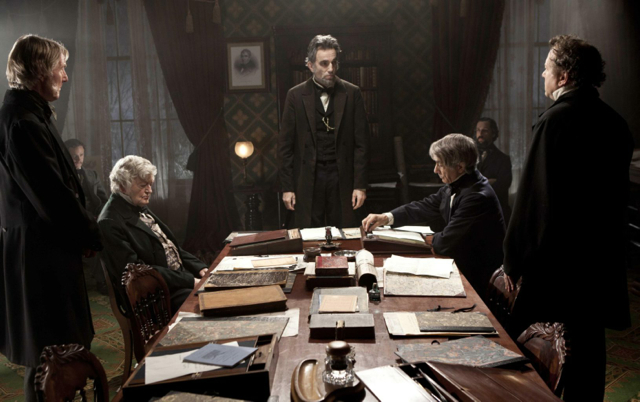
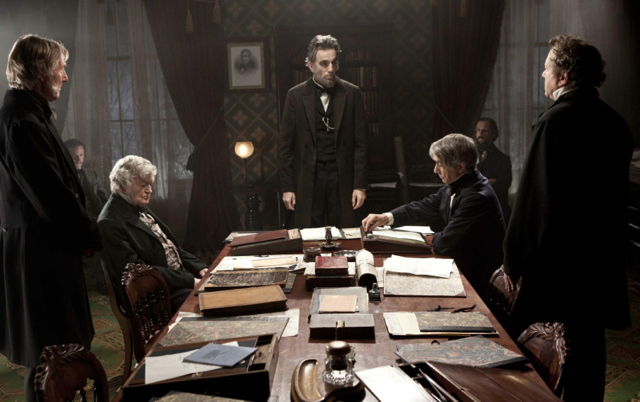
 Daniel Day-Lewis, center, in ‘Lincoln.’ (DreamWorks Studios)
Lincoln, Steven Spielberg’s new film about the final months of the tenure of the 16th president, is set almost entirely in Washington, D.C. But this tale of the capital city in the throes of the Civil War was filmed entirely in Virginia, once the seat of the Confederacy, and today a growing hub for television and film production, even when D.C. is just a short drive away.
Councilmember Vincent Orange (D-At Large) lamented Virginia’s current tourism promotion inviting visitors to see the places where Daniel Day-Lewis portrayed Abraham Lincoln at a hearing yesterday of his Small and Local Business Development Committee. Orange’s committee oversees D.C.’s Office of Motion Picture and Television Development, which while tasked with attracting Hollywood crews to the District, simply can’t compete with other film commissions around the country.
The reason: Tax incentives. Many states, including Virginia, offer generous givebacks to production companies that bring in their business—along with the movie stars, crew members, jobs and hotel stays that come with them. For shooting Lincoln in Virginia, DreamWorks Studios got $4.5 million back.
D.C., on the other hand, hasn’t paid out a cent in film incentives since 2010, the year it gave $1.4 million to the James L. Brooks-directed romantic comedy How Do You Know. (That Lincoln is expected to be an Academy Award juggernaut while How Do You Know was a critical and commercial dud is only a bonus.)
In his hearing yesterday, Orange got feedback on a bill he proposed last month that would create a new film incentive fund he believes would make D.C. more likely to be the production home to the many movies and series that, while set here, are made elsewhere. But Orange’s proposal, which would collect 1 percent of city grants to contractors in order to create funds for film production and public art, was not appreciated by the three witnesses representing the real estate industry. A statement read by a staffer from the office of Victor Hoskins, deputy mayor for planning and economic development, was just as hesitant to embrace Orange’s plan.
Public art installations are already allocated for in the District’s annual budget, under the D.C. Commission on the Arts and Humanities’ capital fund. Meanwhile, though everyone likes meeting movie stars, Orange’s fellow councilmembers have seldom expressed much interest in creating an incentive fund for the film industry.
With Virginia Gov. Bob McDonnell boasting his state’s economy took in $400 million from moviemaking last year, and Maryland moving to triple the value of its tax credit program to $22.5 million, D.C.’s coffers are just that much more unappealing. With Maryland’s plans, Veep, the HBO comedy about a U.S. vice president played by Julia Louis-Dreyfus, has no reason to leave its base in Baltimore.
And other states farther away are being just as aggressive. North Carolina offers visiting movie and television crews a 25 percent refundable tax credit up to $20 million per project. That’s why the D.C. portrayed in Showtime’s CIA drama Homeland is dotted with the skyscrapers that line downtown Charlotte instead of the squat office buildings kept short by the Height Act.
What D.C. gets a lot of, though, is production units tasked with collecting establishing shots—quick takes of the U.S. Capitol or Washington Monument to remind the viewers that the thing they are watching is supposedly happening here. But the real production almost always happens somewhere else.
Orange lamented that fact strenuously when discussing White House Down, a forthcoming action flick depicting a terrorist takeover of the White House. Though a crew from Roland Emmerich’s big-budget thriller stopped in Bloomingdale last month to get a shot of the Capitol dome, the rest of the movie—which stars Jamie Foxx as the president and Channing Tatum as a Secret Service agent—is being filmed at a film studio in Montreal.
 Photo by @bloomingdame
Crystal Palmer, the director of D.C.’s film office, has expressed similar frustrations about losing out on film and television productions in past hearings, but she was not on the witness list yesterday. Orange’s bill seems rather hastily scraped together. One of its programs—the public art fund—is redundant with an existing line item in the District budget. Meanwhile, the office of Chief Financial Officer Natwar Gandhi has yet to release a fiscal impact statement on the effect of skimming 1 percent off the top of District construction grants.
The only praise for Orange’s bill came from Vincent de Paul Zannino, an actor and producer with a scattering of credits, who said that the District needs to offer financial incentives if it has any hope of attracting film crews. He also informed the Council chamber that he has met Tatum.