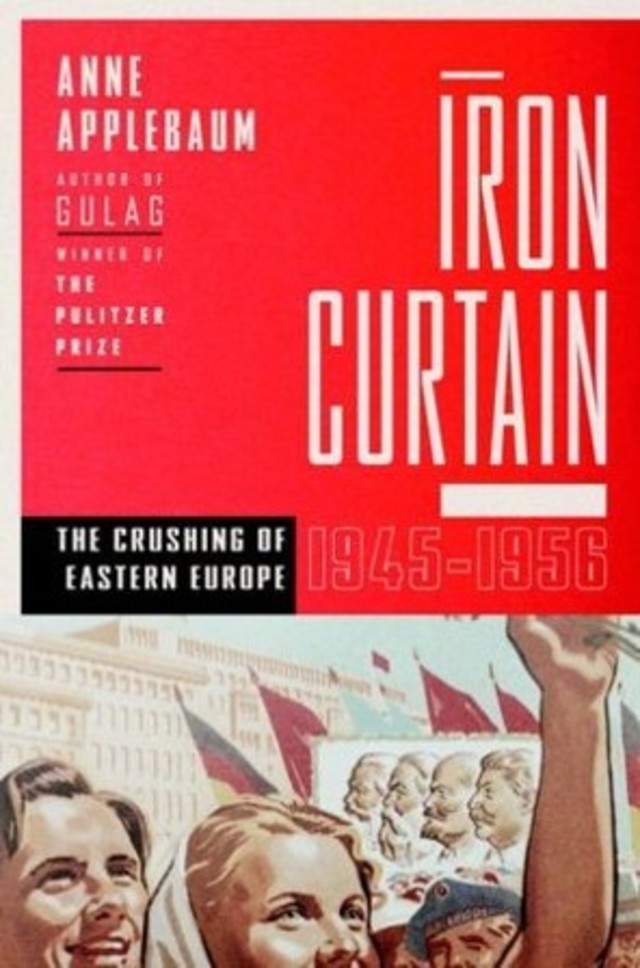
 Lots of history and current events would suggest that people living under totalitarian rule are bound to rise up, in overwhelming favor of democracy. One of the most notorious and fascinating counterexamples is the Communist takeover of Eastern Europe after World War II. Anne Applebaum will be speaking on the subject of her new book, Iron Curtain (Doubleday, October 2012), at Politics and Prose tonight at 7 p.m.
In 1945, Soviet Union Premier Joseph Stalin embarked on a mission to bring communism to all European nations, which already had their own distinct cultures, languages, and government establishments. Applebaum says she wanted to explain their takeover “from the ground up” — how freedoms were shed, and how certain groups went along or resisted it. She explores not only the political consequences, but the longer-term impact on morality, civil behaviors, and everyday life.
Her book has been described as kind of a Totalitarian Takeover Manual. First steps like targeted violence, media control and content creation made for a vulnerable state. For instance, scripted “show trials” punished turncoat communist officials, and were broadcast by radio and newspapers to incite fear in and out of the party. The countries’ youth was targeted first and aggressively. And artwork had to be commissioned by the Soviet state in hopes that life would imitate it; abstract art was banned because it could be interpreted in too many ways.
The author details how exactly Stalin and his secret police managed to sway the masses and infiltrate their lives. Newly released documents from the archives of the Communist bloc, including interviews and personal accounts, illustrate how communism truly affected individuals and families in the region. Applebaum also comments on how a similar situation could soon arise in Latin America.
Tales from Iron Curtain compel us to learn from the past, consider the role and limitation of government, and maybe even think twice about our relaxed approach to personal privacy, with informative online profiles and dutiful “check-ins” that “Big Brother” would have surely appreciated.
The Washington Post and Slate columnist won the Pulitzer Prize for her 2004 book on Soviet concentration camps, Gulag, and Iron Curtain was a 2012 National Book Award Finalist. She has been editor and columnist of several British newspapers and reported on the collapse of communism as The Economist’s Warsaw correspondent. She splits her time between Washington, D.C. and Poland, as she is married to Polish Foreign Minister Radek Sikorski.
Politics and Prose’s in-store events are free and open to the public. Applebaum will be signing copies of Iron Curtain following her talk and question-and-answer session this evening.