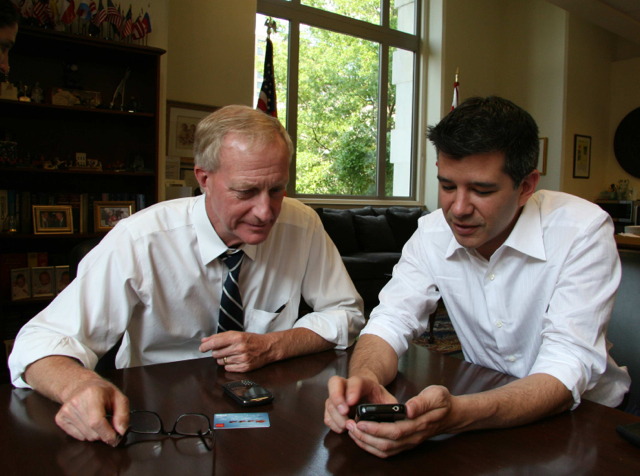
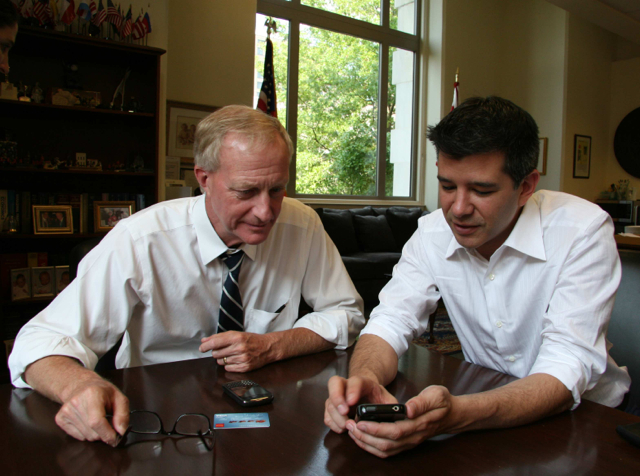
 Uber CEO Travis Kalanick, right, shows his company’s smartphone application to Councilmember Jack Evans (D-Ward 2).
Travis Kalanick, the founder and chief executive of the livery sedan dispatching service Uber, has some new friends: Members of the D.C. Council.
That Kalanick and the inhabitants of the John A. Wilson Building are now best buds comes only months after Uber’s customers rose up in outrage over the Council’s previous attempts to pass legislation affecting the company. But with the passage yesterday of a bill that clarifies the legal status of so-called “digital dispatch” services—i.e., Uber and other companies that offer users the ability to request a car-for-hire through a mobile application—Kalanick is now singing some councilmembers’ praises.
In particular, Kalanick thanked Mary Cheh (D-Ward 3), who sponsored yesterday’s legislation. It was just in July that Kalanick lashed out at Cheh for attempting to pass an earlier version of the sedan legislation that would have implemented a price floor on Uber’s services, even though the company did negotiate such a detail.
Now, though, they’re pals.
“I’m on a long road,” Kalanick said on a conference call with reporters after yesterday’s vote. “It’s one where at the end of the day, the city council i think really responded boldly and really listended to their constitutioents. I felt listened to how we view the world. Held our feet to the fire to make sure city’s interests were taken into account. I’m pretty excited.”
Under the newly passed legislation, Uber’s pricing model will not be regulated, though its drivers will be required to submit trip data back to the D.C. Taxicab Commission, and the company will have to better inform its customers that drivers are rating them just as much as riders review drivers.
Though Uber always viewed itself as street-legal, regulators didn’t always agree. “What we found very quickly is though we were fine under existing regulations, we were new,” Kalanick said.
The sedan legislation is also novel in that it combines the application process for taxi, sedan and limousine into a single license and exam, which will be offered by the D.C. Taxicab Commission for the first time in four years.
“I became worried at certain periods when I heard about the taxicab commission fining drivers and trying to shut down Uber,” said Robert Harrison, a sedan driver who became an Uber affiliate in April. “It’s been a great opportunity for me and I’ve been very proud to be an Uber partner.”
Uber might be safe in D.C., but as it still faces other legal challenges in other markets in which it operates. It is the target of lawsuits filed by cabbies in Chicago and San Francisco, and has also had run-ins with regulators in New York and Cambridge, Mass. Yesterday, the California Public Utilities Commission announced it would investigate Uber and similar companies.
But right now, Kalanick seems pretty happy with a city that gave him a lot of grief since his company arrived a year ago.
“D.C. is basically leading a charge in embracing this kind of innovation and setting a standard for how other cities should be looking at this kind of innovation,” he said.