 Photo of Mendelson by Mr. T in DC
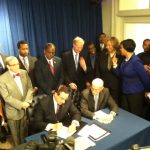
Phil Mendelson, the chairman of the D.C. Council, gaveled the body into session yesterday at 10:54 a.m. Eleven hours and 20 minutes later, the District’s elected legislators finally finished their business for the day, after muddling through some 80 bills, amendments, and resolutions, wasting the time of relevant stakeholders, and leaving many observers exhausted with the democratic process.
That the Council was backloaded with paperwork is hardly news for any legislature, members told DCist. But what really cheesed off Mayor Vince Gray was that the funds called for by the measures deliberated yesterday add up to nearly $350 million in unfunded appropriations over a four-year period.
“I don’t think it’s fair to the public,” Gray said shortly after cutting a ceremonial ribbon on a new bicycle lane on L Street NW in downtown D.C.
In particular, Gray pointed to the first reading of a bill that would lower fines issued to motorists caught violating driving laws by the city’s network of traffic cameras. The District raised $178 million in revenue from traffic cameras during fiscal 2012, with much grousing by drivers to spare. While Gray recently lowered some speeding fines, his plan offset resulting losses by drastically increasing the penalties for the most severe infractions.
But the Council, in response, moved unanimously to lower most fines by $50 in a bill that passed its first reading yesterday over the economic objections of Natwar Gandhi, D.C.’s chief financial officer. In a fiscal impact statement, Gandhi warned councilmembers that slashing traffic-fines to make heavy-footed drivers a bit less punished would cost the District $95.8 million between now and the end of fiscal 2016.
“You could reduce [traffic fines],” Gray said. “It undermines my plan to add 100 new police officers.”
There were plenty of other examples of bills, some very well-intentioned, that Gandhi has said are unaffordable. A bill to create a $1 million fund to relieve residents of Bloomingdale and LeDroit Park from the flood damage they experienced last summer by levying a 30-cent charge on all residents’ monthly water bills received the blessing of all councilmembers save Muriel Bowser (D-Ward 4).
Gandhi’s report on theanother bill related to the flooding, though, objected to a provision authorizing the installation of backwater valves—devices that prevent sewage from burping up a house’s pipes and drains—on as many as 2,200 homes across the flood-prone neighborhoods. Such an undertaking, which Gandhi expects would include the recruitment of contractors to handle the actual labor, could cost as much as $5.5 million over four years.
As for the flood relief fund, while Councilmember Jim Graham (D-Ward 1) pointed out it made for humane politics, no one on the dais aside from Bowser questioned the sensibility of tacking on a 30-cent fee on all city residents’ water bills. And Gray has said that the federal government, which uses the same water table for its plumbing needs, might not abide such an order. Then there’s D.C. Water itself, which at the end of 2011 reported a $20.5 million operating surplus. (According D.C. Water officials, that surplus has already been divided up. Just over $4 million will be provided to customers in the form of a rebate starting in January.)
“It’s highly irresponsible to legislate in that manner,” said Gray’s spokesman Pedro Ribeiro. “It gives a false sense of hope.”
Another bill that would require funding was an expansion of neighborhood library operating hours offered by Jack Evans (D-Ward 2), who otherwise often plays the role of the Council’s fiscal hawk. According to Gray’s office, the plan would cost $30 million over four years, not an insignificant amount considering that Gray only barely managed to scrape together the $300,000 needed to keep the Martin Luther King, Jr. Memorial Library open on Sundays last year.
Many of the bills the Council passed yesterday will eventually wind up the subjects of appropriations hearings. Though D.C. has finished the past two years with budget surpluses, Gray’s administration has used those figures to pad the city’s cash reserves rather than replenish programs that have had their budgets slashed. D.C.’s rainy-day fund has grown the past few years, but not enough to satisfy every one of the Council’s legislative whims.
“The obvious concern is the false expectations the Council will create by raising a lot of peoples’ hopes for legislation that will likely never take effect,” Ribeiro wrote in a subsequent email.
Of course, not every bill up for debate yesterday featured a socially redeeming angle. Some were merely vanity projects, perhaps no more blatant than Councilmember Vincent Orange’s (D-At Large) proposal to create a film production incentive fund as a way to lure Hollywood to the District for more than just the occasional establishment shot.
If Orange had his way, the District would collect 1 percent of city grants to contractors in order to create funds for film incentives and mounting works of art in government buildings. The scheme was sharply rebuked by developers and D.C. officials who testified at Orange’s hearing last week, to say nothing of the fact that D.C. already has a public art program budgeted in its Commission on the Arts and Humanities.
Still, that hearing didn’t discourage Orange from pushing the bill yesterday as a piece of emergency legislation, even though D.C.’s lack of a film industry has not yet reached a full-blown panic.
Orange’s bill passed unanimously, but only after it was watered down to a “sense of the Council” resolution with no possible funding attached. In his review of the bill, Gandhi warned that had it been adopted at full strength, it would deplete D.C.’s coffers by $20 million in its first year alone, and by $80 million by 2016.
As the debating, scheduling, grandstanding, and voting bored on, councilmembers defended the 80-bill day as an occupational inevitability.
“It’s a feature of many legislative bodies not uncommon for the end of a session,” Mary Cheh (D-Ward 3) said of the papery pileup.
Mendelson seemed a bit stunned when told that some called yesterday’s Council session irresponsible. “Every legislature does it,” he said gruffly. “Look at Annapolis. Look at Richmond.”
Though the norm they may be, legislative meetings that stretch deep into the night because a chamber needs to clear out a fattened backlog before closing a session is not a terribly endearing habit. In fact, they can often lead to governing on a razor’s edge.
Pennsylvania is required to finish its annual budget by July 1 every year. Gov. Tom Corbett signed this year’s $27.7 billion budget on June 30—at 11:45 p.m. The Patriot-News of Harrisburg was not impressed:
While we can all be glad the string of late budgets that happened under Gov. Ed Rendell is broken, the question remains why lawmakers still are working out a spending plan that is introduced in February at the last possible moment on June 30?
And, additionally, why did the Legislature finish up its work on other bills, before heading out of town for the summer, at an hour when most Pennsylvanians were sound asleep? Couldn’t it have reconvened on Sunday or even Monday during the day as a few House Democrats suggested?
And in Wisconsin, the state assembly finished its most recent legislative session in an even drearier fashion. It took 33 hours for members to trudge through a ream of bills that had stacked up all year. But the Milwaukee Journal-Sentinel, in a vinegary editorial surely fueled by partisan rancor forcing its writers to stay up past their bedtimes, called the Methuselan session out as one in a worrisome trend:
Pulling an all-nighter in college is one thing. Pulling an all-nighter as a Wisconsin legislator is quite another. It’s no way to legislate—no way to conduct the people’s business.
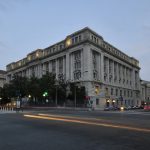
Is D.C. headed down the same path? For some of the bills considered yesterday at the John A. Wilson Building, it was just the first reading. The Council will convene again in two weeks for its final pairing of Committee of the Whole and additional legislative sessions of 2012. And any bills not adopted by the end of the year will have to go through the entire motion once again. Hence the parliamentary gluttony.
Still, even Cheh admitted that not everything passed will get its anticipated funding. “Some of these are going to wind up on the cutting-room floor,” she said.
But for now, the Council expressed its support for an $11 million tax abatement for Howard Town Center, a planned residential and retail development on the 2100 block of Georgia Avenue NW. Gandhi, often a backer of tax breaks for big real estate deals, said that the District could not afford to give Howard University and the development company CastleRock Partners a combined $1.1 million a year over the decade beginning in 2015.
Gandhi’s demurral on the tax break prompted a rare instance in which the D.C. Fiscal Policy Institute, an economic watchdog group, agreed with the District’s CFO. Not only did the institute’s research find that CastleRock doesn’t need the money, it agreed with Gandhi’s assessment that the advertised rents at Howard Town Center are being kept artificially low.
Mendelson, who also opposes the abatement, forced a separate voice vote on the measure.
It passed, 8-4.
Correction: This article initially suggested the proposals to create a flood relief fund in Bloomingdale and LeDroit Park and to install backwater valves on homes in those neighborhoods were a single piece of legislation. They are separate.