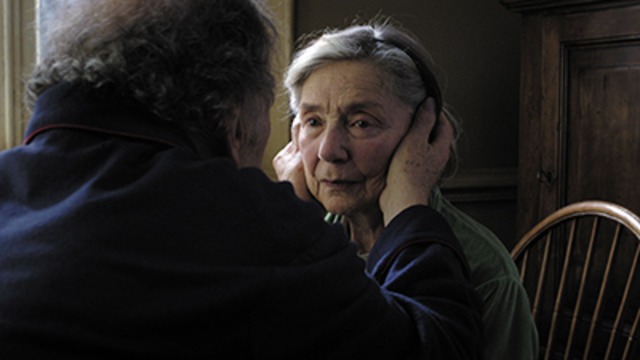
 Jean-Louis Trintignant and Emmanuelle Riva (Sony Pictures Classics/Darius Khondji)
Retired piano teacher Anne (Emmanuelle Riva) has had a second stroke that has devastated her ability to communicate in much more than cries of pain. Her husband Georges (Jean-Louis Trintignant) has honored her wishes not to send her back to the hospital, and cares for her on his own, the couple’s grown daughter (Isabelle Huppert) offering complaints and little else. At her sickbed, Georges tries to sooth another of his wife’s bouts of pain. As she cries out, “Hurts! hurts!” he tells her a story of being a child at camp. Refusing to eat the rice pudding offered his fellow camp mates, he is punished with isolation and loneliness. When the young Georges is soon after diagnosed with diphtheria, he is kept even further in isolation, his mother only able to wave at him through glass.
Michael Haneke is not one of our warmest directors. The buzz on his latest film, nominated for several Oscars including Best Picture, Actress (Riva) and Director, is that that this is the film where the seventy-year old Austrian warms and mellows.
I don’t think so.
Art doesn’t have to be soft, but when hardness becomes a straitjacket, it replaces one easy answer with another, and does so at the expense of the nuance and richness of a worldview without rose-colored or black blinders. Despite Amour’s surface service to the hard struggles of life and devotion in a long marriage, Haneke is playing with the same themes of alienation and isolation, repression and bleakness that have marked his entire career. The pair of lead performances makes it convincing to a point, but these poor characters are merely players in a signature act of desperation, Haneke style.
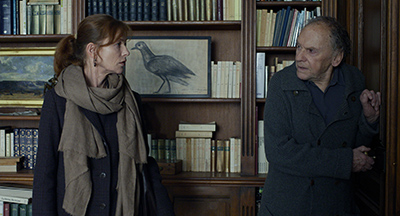 Isabelle Huppert and Jean-Lous Trintignant (Sony Pictures Classics/Darius Khondji)
Amour begins with a home invasion, which recalls his 1997 film Funny Games but to a different end. Or is it so different? Funny Games, which the director remade in English in 2007, supposedly subverted audience tastes for horror and thrills with its cold eye on a brutal break-in, using the techniques of cinema to provoke B-movie visceral reaction in an arthouse context. This time it’s the police that break into a shuttered apartment. A corpse is revealed, and so is the title: Love.
The rest of the film works back from this inevitable ending. George and Anne’s apartment has been sealed off, much in the way that Haneke seals himself off from emotion and its rewards. It is a powerful sight to see Riva and Trintingant, both icons of the French New Wave, follow the steps of their death dance, but although their accomplishment as actors rings a note of triumph, this is after all a Michael Haneke picture, and triumph, especially in the face of death, is forbidden. Amour artfully conveys the difficulty and tedium of a long life, and brings it to the pointlessness and despair that he chooses to show. A desperation where a stray pigeon that is his final visitation from the outside world becomes a much needed specimen of life, too little, too late.
—
Written and directed by Michael Haneke
With Jean-Louis Trintignant, Emmanuelle Riva, Isabelle Huppert.
Running time 127 minutes
Rated PG-13 for mature thematic material including a disturbing act, and for brief language
Opens today at E Street Landmark Cinema and Landmark Bethesda Row