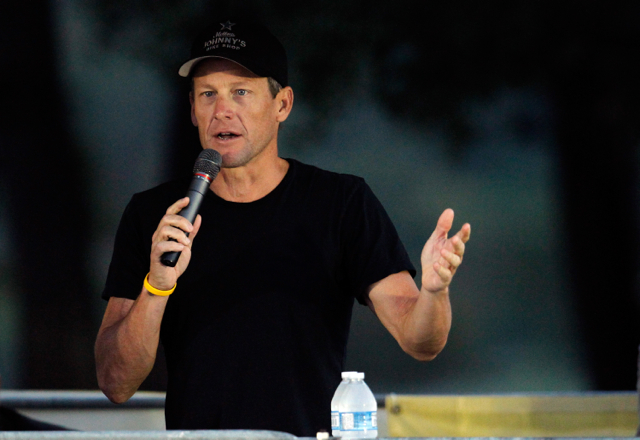
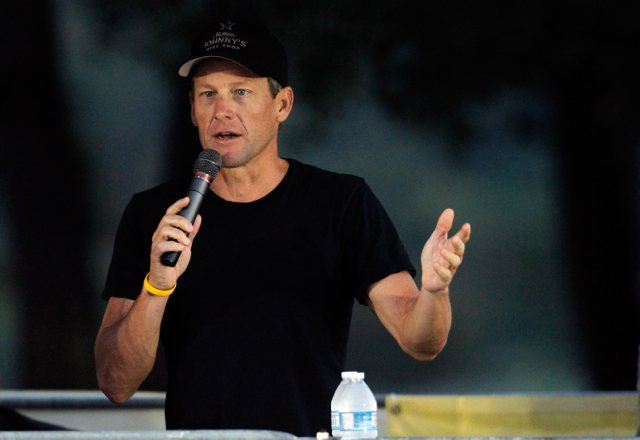
 Armstrong in October 2012. (Getty Images/Tom Pennington)
Lance Armstrong, the disgraced cyclist who admitted in an interview with Oprah Winfrey earlier this week that he doped to get ahead of other professional riders, has been apologizing to his family and closest friends. Including, it would appear, to The Washington Post’s Sally Jenkins, with whom he has co-authored two books.
Jenkins, of course, is also perhaps the least fazed person in the world that Armstrong cheated during his historic—and now totally invalidated—career. The Post sports columnist was a guest on Charlie Rose last night and said that Armstrong admitted to her that he doped and apologized for it.
Still, even though Jenkins heard from her good friend Lance that he had been pulling the wool over the world’s eyes, she’s not really that mad. “I had hoped he was clean. He’s not,” she told Rose. “Am I angry about that? You know, I don’t rise to the level of anger that I think a lot of people want me to. I think that there’s a level of anger at Lance that is out of proportion to the offense of doping.” (Kudos to D.C. Sports Bog’s Dan Steinberg for transcribing.)
Basically, Jenkins’ outlook on Armstrong really isn’t that different than it was in her passionate defense of him last month, in which she excused Armstrong’s doping because everyone else was doing it (largely true) and some squishiness in how the U.S. Anti-Doping Agency—not a government apparatus, despite the name—investigated Armstrong. But the federal government may become a lot more involved depending on whether it decides tomorrow to join a lawsuit seeking to reclaim the sponsorship money the United States Postal Service sent Armstrong’s way during his drug-induced heyday.
So, is Jenkins aware that Armstrong can kind of be a jerk? Maybe. But her hero worship continues regardless. When Jenkins wrote her December love letter, she couched all of Armstrong’s competitive misdeeds against his charitable work as a fundraiser for fighting cancer and his willingness to visit sick kids in the hospital. “I don’t just like Lance Armstrong for that. I love him for it,” she wrote.
That much seems unchanged judging by what Jenkins told Rose last night:
The cancer fighter was the guy that I liked very much, and respected, and enjoyed working with. And that part of him is still intact. For better or worse, our greatest cancer fighter happens to be a guy who also took some chances with his health. And that’s an interesting fact.
Greatest cancer fighter? At this point, “greatest” can refer only to Armstrong’s outsize public status, not his ethical or medical conditions. It’s fair to say there might not have been a more famous cancer patient in recent history than Lance Armstrong, but after his expected admission to Winfrey tomorrow that all those inspiration magazine profiles, weepy SportsCenter packages, and prolific Tours de France victories were predicated on bullshit and blood cleansing, is he really the cancer fighter we want?
As far as Jenkins is concerned, he’s still the cancer fighter we need. And that’s an unsettling proposition.