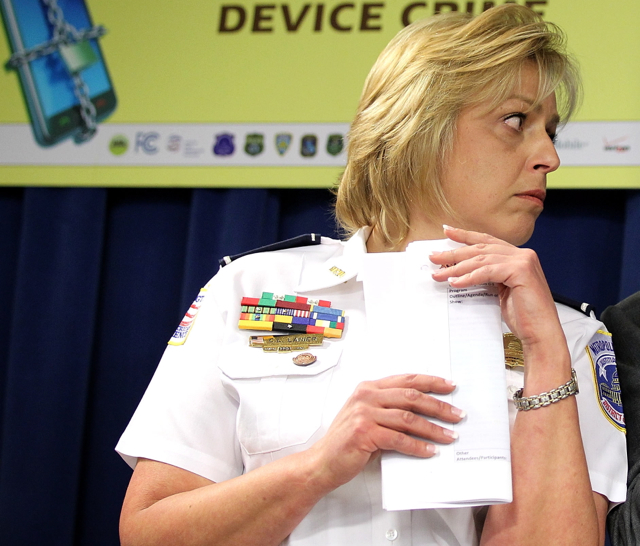
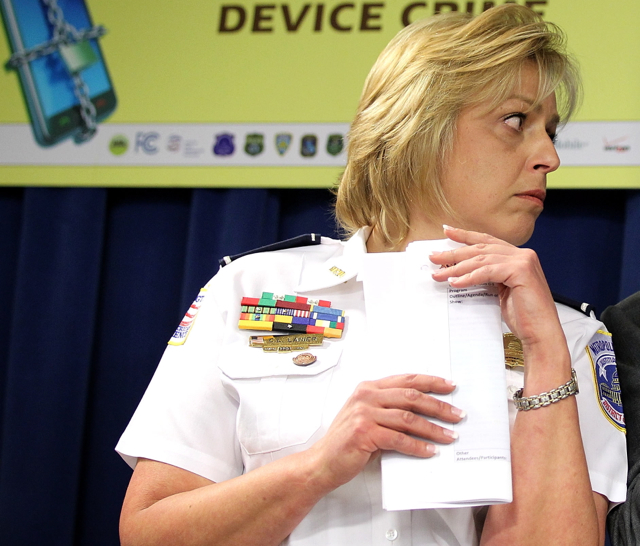
 D.C. Police Chief Cathy Lanier in April 2010 (Getty Images/Alex Wong)
In a damning report released today, researchers at Human Rights Watch say the Metropolitan Police Department reports an artificially low number of sexual assaults with a remarkably high clearance rate, when in fact the reality is a pattern of victim-shaming and unfinished investigations. The report, titled “Capitol Offense,” is the work of Sara Darehshori, a senior counsel at Human Rights Watch, and documents three years’ worth of sexual assault cases.
Darehshori and her team found in many of the cases they reviewed that officers failed to file incident reports, wrongly classified sexual assaults as lesser crimes, or, in some instances, pressure victims into recanting their allegations. Between October 2008 and September 2011, MPD noted 571 sexual assault cases in their criminal statistic reports to the Federal Bureau of Investigation. Darehshori writes that figuring in the rate of sex-crime victims who go untreated at hospitals—the national average is 41 percent—MPD should have been reporting at least 739 incidents in the studied period.
Human Rights Watch alleges MPD’s numbers were low over the three-year span not because D.C. experiences a lower rate of sex crimes, but because police methods reported in more than 150 interviews led to investigations being dropped and victims feeling like investigators blamed them. Some of the allegations featured in the 197-page report are particularly chilling:
Police telling a victim she was wasting their time:
[The detectives] told me that they did not want to waste their time with me … that no one was going to believe my report and that he didn’t even want to file it…. When I called to get the police report number [the detective] told me it was a ‘miscellaneous’ report…. This is not ‘miscellaneous’ THIS IS RAPE!
A detective says he doesn’t believe a victim’s story:
To hear him tell me he didn’t believe me was a slap in my face. It just knocked me down, it was a punch in my stomach. It just took the air right out of me. And where do you go from there when the policeman tells you he doesn’t believe you?
A nurse recalls a detective’s response to a victim who required emergency surgery after coming into the hospital with severe vaginal and rectal tears:
“Well, she could have fallen on rocks and may not have had panties on. Also what kind of girl is in a room with five guys?”
Victim feels shamed by her conversation with police:
They just didn’t listen to me, they made me feel completely ashamed of myself, they made me feel like I was lying or like I was too stupid to understand what happened to me, that I was trying to make something a big deal that wasn’t that big of a deal.
In an interview with DCist, Darehshori says the number sexual assault incident reports MPD filed increased in June after the department learned of Human Rights Watch’s investigation. But that doesn’t exactly clear up a December statement by Chief Cathy Lanier that MPD provided 1,080 incident reports to Darehshori’s team. Included in that batch of documents, Darehshori says, were many reports that were not germaine to her study. In fact, she says, MPD offered her more than 1,300 reports, but 780 were “irrelevant,” including 117 juvenile incidents and 350 cases of “minimal sexual contact” such as over-the-clothes groping. Human Rights Watch’s report looks at victims who were treated at Washington Hospital Center, which is D.C.’s designated hospital for forensic examinations of adult sexual assault victims.
“We were looking into to whether an investigation was carried out,” Darehshori says. She adds that police told her that many of the complaints that went without a full investigation were still entered into a departmental database, but that is of little worth. “Entry into the database doesn’t indicate an investigation. We provided them with a list of dates and still couldn’t find documentation for 170 cases.”
In a blistering statement hitting back at Human Rights Watch, Lanier says the report is based on a “flawed methodology” of stacking hospital reports against PD-251’s, the internal term for an incident report. Moreover, Lanier says that by alleging that many sex crimes are going without investigations, Human Rights Watch is discouraging victims from coming forward.
“Secondly, the insinuations in HRW’s report that MPD has a culture of under reporting or not investigating cases will ultimately have a chilling effect on victims of sexual abuse and will discourage them from reporting crimes,” she says.
Darehshori disagrees, saying the burden is on Lanier’s department: “The reputation of MPD right now is that it is treating victims badly. I think what would encourage them to come forward is an expresion from the police department that this behavior will be addressed and will not be tolerated.”