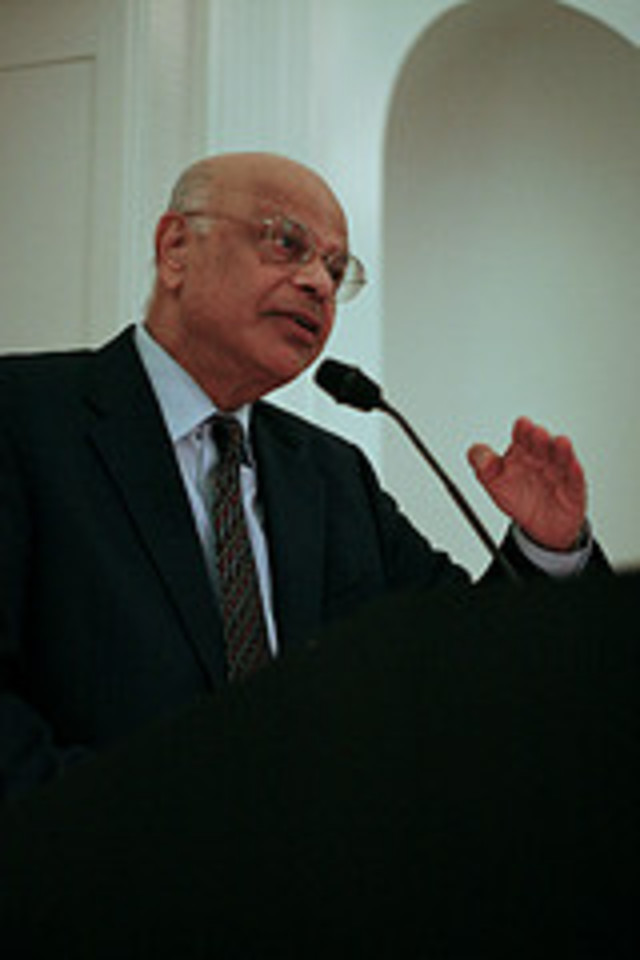
 D.C. CFO Natwar Gandhi. Photo by DCCA.
While Mayor Vince Gray and other District officials celebrated earlier today the announcement of a $417 million budget surplus in fiscal year 2012, some advocates for affordable housing and other anti-poverty programs are disappointed the entire sum was added to D.C.’s cash reserves.
The D.C. Fair Budget Coalition, which pushes for increased spending on low-income housing, aid for the city’s homeless population, and public health measures, said in a press release that rather than bank the entire surplus, D.C. officials should have spent half on “investments in D.C. residents and neighborhoods.”
But at a media briefing and subsequent press conference several District officials—including Mayor Vince Gray and Chief Financial Officer Natwar Gandhi—reminded reporters of a 2010 law requiring the city to turn any budget surpluses over to its emergency fund until reaching a balance capable of sustaining government operations for two months. The $417 million added at the end of fiscal 2012 brought the fund up to some $1.5 billion, but officials estimate another $286.2 million will need to be added before the two-month cash supply is reached, after which the city can begin using surplus funds on additional expenditures.
The Fair Budget Coalition disagrees.
“That’s the myth they like to tell,” Janelle Treibitz, a spokeswoman for the organization, says. “Our understanding is that it is very easy for the mayor to find ways to access money in the fund while it’s there or to just change the law so that that money can be freed up to address urgent human needs.”
The coalition’s press release states that even before the latest infusion, D.C.’s emergency fund was the eighth largest in the United States relative to population. “We’re not trying to say, ‘Don’t save any of the money’,” Treibitz adds. “If this was your own personal budget and you had some kids starving, would you feed your kids or put it all in their college fund?”
Gray said today that he plans to call for increased spending on low-income housing and other anti-poverty programs next week during his State of the District address. In the mean time, though, budget officials insist that keeping up the city’s cash reserves is critical to maintaining an affordable bond rating for when the government borrows money.
“The CFO agrees that his estimates are conservative, but not overly conservative,” Gandhi’s spokesman David Umansky writes in response to the Fair Budget Coalition’s accusations that Gandhi’s projections are “intentionally” modest. “The problem with not being conservative is that a deficit could occur and bring back the Control Board and cause significant increases of the interest rates on our bonds,” Umansky adds.
But Treibitz says her group would rather see the District government make a few one-time investments. “Save half, spend half,” she says. “This is a missed opportunity.”