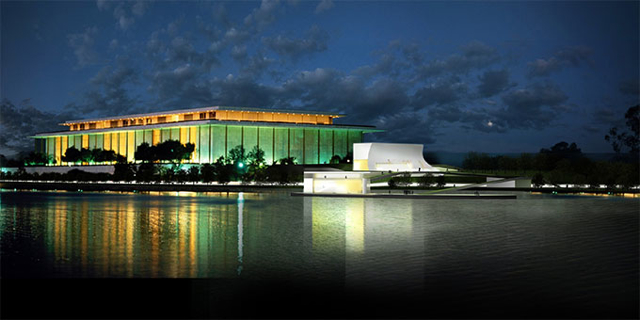
 Rendering by Steven Holl Architects via Kennedy Center
Get ready for the John F. Kennedy Center for the Performing Arts to increase its already hulking position on shores of the Potomac River. The center announced today a $100 million expansion project that will add 60,000 square feet of performance, rehearsal, and educational space spread across three pavilions—one of which will actually be floating on the river.
The project, which is slated to take five years to complete, is not that large considering the Kennedy Center’s existing 1.5 million-square-foot footprint, but it is designed to accomodate several functions that the venue cannot support right now, namely classrooms for its educational programming and a practice venue for the Washington National Opera, which currently rehearses in Takoma.
Architects Steven Holl and Chris McVoy, of Holl’s eponymous firm, are responsible for the design, that also includes extensive green space between the planned pavilions and the existing Kennedy Center.
The pavilion that will hang out over the Potomac will also feature an outdoor stage. As sketched out by Holl and McVoy, the finished pavilions—constructed from glass and the same kind of Italian marble from which the Kennedy Center is constructed—will be connected by a series of underground tunnels, preserving the “silhouette” of the original structure.
Since opening in 1971, the Kennedy Center has never undergone an expansion. A proposed $650 million expansion was scuttled in 2005 after Congress pulled $400 million in federal funding.
This plan, though, is set to be privately financed, with half the $100 million cost being fronted by David Rubenstein, the chairman of the Kennedy Center’s board of directors. “With Mr. Rubenstein’s $50 million lead gift, the Kennedy Center has begun a major fundraising campaign of $125 million,” a Kennedy Center press release reads. “$50 million more for the expansion project and an additional $25 million for major programming initiatives in the years ahead.”