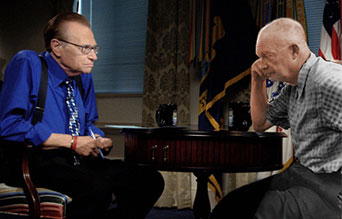
 Via Ike 2012
The long-running fight over the design of the forthcoming Dwight D. Eisenhower Memorial took a weird, though little noticed, turn last year when the commission responsible for the project’s design and funding launched a strange website to promote the 34th president’s image.
The site, Ike 2012, was introduced last fall by the Eisenhower Memorial Commission in hopes of “bringing Eisenhower’s legacy to a contemporary 2012 electorate.” On a slickly designed page, “Ike 2012” offers a brief biography of Eisenhower, but it’s the site’s other details that are giving Ike fans pause.
Eisenhower appears in modern-day settings, thanks to the apparent magic of photo-editing software that places him in scenes such as Chicago’s unsuccessful bid to host the 2016 Olympic Games, greeting a U.S. Olympic baseball team, or being interviewed by the likes of George Stephanopoulos and Larry King. Much like the 1994 film Forrest Gump used digital trickery to inserted Tom Hanks into archival footage, a similar device was used to bring Eisenhower into the present.
“It just shows how Mickey Mouse the Eisenhower Memorial Commission has been,” says Justin Shubow, the head of the National Civic Art Society, a group that has been sharply critical of the architect Frank Gehry’s design for the Eisenhower Memorial.
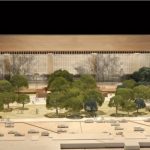
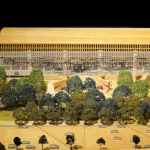
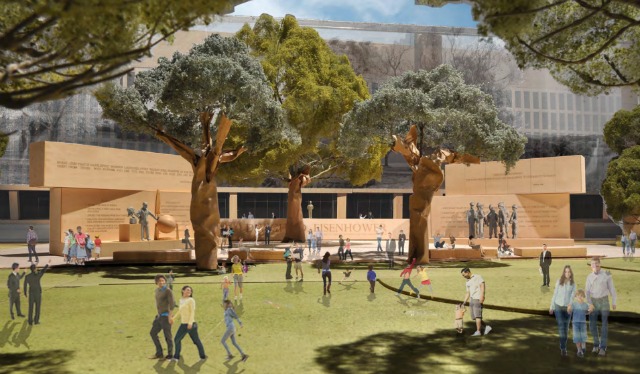
Shubow’s group, along with members of the Eisenhower family, have long opposed Gehry’s plans, which shifted from depicting the general and president as a “barefoot boy” in Kansas to a life-size, “unrecognizable” cadet surrounded by 80-foot pylons and a steel mesh.
The Ike 2012 site, Shubow, says, only adds to the “feel-good, meaningless nostalgia” he believes the memorial’s design is pushing. Though the page has been up for several months, Shubow says he only spotted it earlier this month. Susan Eisenhower, the president’s granddaughter, writes in an email that she has not yet seen it.
But for Shubow, the site’s presence is another blow to Eisenhower’s legacy. “This is representative of the lack of dignity with which they have treated him,” he says. In a press release earlier Thursday, Shubow demanded that the Eisenhower Memorial Commission pull the images down. However, the shots of Dwight D. Eisenhower are credited to his presidential library, which houses a large volume of government photographs taken during his presidency that are now in the public domain.
Still, it is odd to see Eisenhower edited into a modern-day scene, whether posing with a victorious baseball team or greeting Queen Elizabeth II. Actually, the latter is especially bizarre considering one does not need to consult Adobe Photoshop to conjure an image of Eisenhower and Elizabeth, who made her first state visit to the United States in 1957.
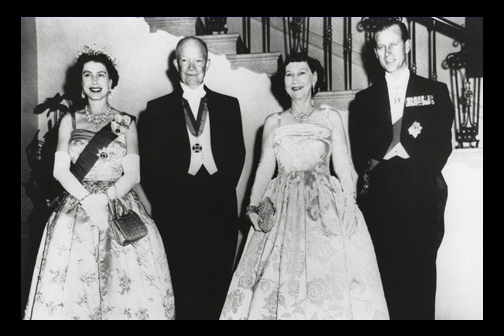 From left: Queen Elizabeth II, President Dwight D. Eisenhower, Mamie Eisenhower, Prince Philip (National Park Service/Abbie Rowe, via White House)