Martin Austermuhle
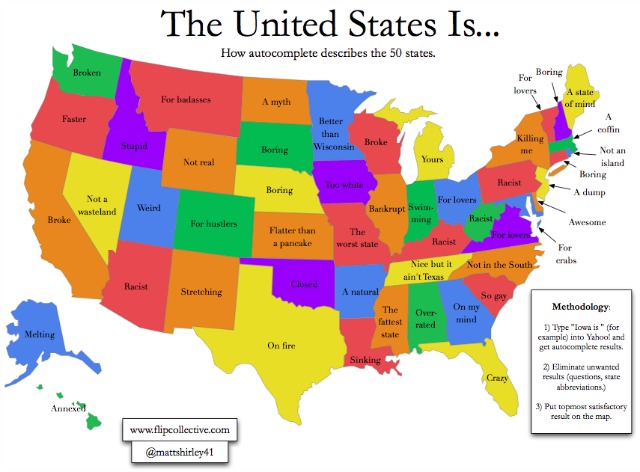
Search engines are wonderful things. Their algorithms help us find any manner of information floating out in cyberspace, and they now feature auto-complete functions that help narrow down what you might be looking for based on the most popular searches and your own search history.
Yesterday the folks over at FlipCollective wanted to put auto-complete to the test: they used a popular search engine’s auto-complete function to determine how they describe each of the country’s 50 states. To do that, they would enter the name of a state followed by “is” and write down the top results. So, for “Iowa is…”, Yahoo!’s auto-complete’s top relevant result was “too white.”
The full map of results is here. Locally, Virginia came up “for lovers” (its state tourism slogan) while Maryland came up “for crabs,” its most notable culinary export. Pennsylvania and West Virginia got “racist,” while Delaware got “awesome.”
Sadly, D.C. wasn’t included in the search—we’re not a state, a fact we’re all too aware of. Still, Washington state seems to have been tainted by association—it came up as “broken.” The Evergreen State can’t be happy with that one.
We did our own quick searches for D.C., though, and the results are somewhat dispiriting. The top result in Yahoo! was “Washington d c is the capital of what state,” followed by “why d c is not a state” and “Washington dc is in what state.” (The results I got are below; they will vary slightly by person.)
For Google, it was much the same: “d.c. is in what state.” (We’ve also heard reports of “d.c. is hollywood for ugly people.”) If you remove the periods in “D.C.”, it gets no better: Yahoo! returns “dc is going to hell,” but more positively also grabs “dc ist.” Google gets “dc is boring.” Bing also gets “d.c. is in what state,” further cementing the fact that neither geography nor history is America’s strong suit.