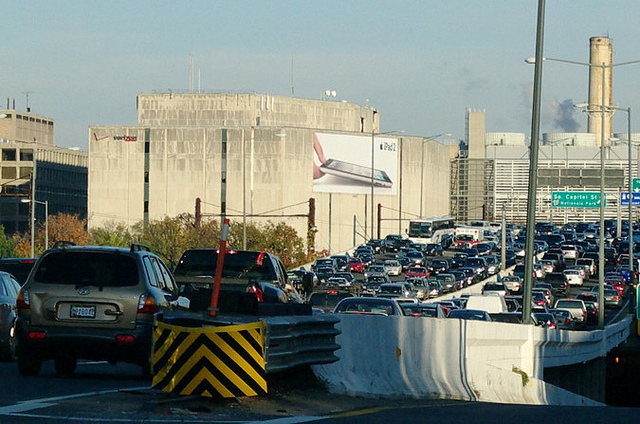
 It stinks! It stinks! It stinks! (Photo by philliefan99)
Like the unbreakable pull of gravity, traffic in the D.C. area continues to be ranked the worst in the United States, according to an annual study by researchers at Texas A&M University. The school’s Transportation Institute is out with the latest edition of its Urban Mobility Report, measuring commute times, wasted hours, needlessly expended fuel, and other effects of nasty gridlock patterns.
And, after looking at a year’s worth of data, researchers concluded that the Washington area suffers from the worst traffic patterns of any very large metropolitan area, with the average driver losing 67 hours to gridlocked roads and 32 gallons of gasoline. Put in to even more tangible terms, D.C.’s bad traffic cost the average driver an extra $1,398 in 2011, the year from which Texas A&M collected the data.
But here’s the worse news: It won’t get better. By 2020, the report finds, national traffic trends will become even more expensive and wasteful. In 2011, the nationwide cost of congestion was $121 billion; the Texas A&M study projects that figure to rise to $199 billion by the end of the decade, at which point American drivers will be wasting a collective 8.4 billion hours and 4.5 billion gallons of fuel per year.
The Los Angeles and San Francisco metropolitan areas tied for second in lost commuter hours, followed by New York, Boston, Houston, Atlanta, Chicago, Philadelphia, and Seattle. Washington finished fourth in the Transportation Institute’s Travel Time Index, which measures the ratio of driving time at peak hours compared to how long it would take to drive the same distance on empty roads. The D.C. area’s figure was 1.32, meaning a trip estimated to take 20 minutes averages about 26 minutes and 24 seconds with the region’s usual traffic.
Nasty gridlock creates problems for commuters and commerce alike everywhere, but with the nation’s biggest cities, especially Washington, busting through the limits of acceptable traffic patterns, it gets to be very expensive.
“We all understand that trips take longer in rush hour, but for really important appointments, we have to allow increasingly more time to ensure an on-time arrival,” Bill Eisele, one of the Urban Mobility Report’s authors, said in a press release. “As bad as traffic jams are, it’s even more frustrating that you can’t depend on traffic jams being consistent from day-to-day. This unreliable travel is costly for commuters and truck drivers moving goods.”
Furthermore, all this traffic is as bad for public health and the environment as it is for the economy. Cars idling on highways and surface street have little to do more than suck gasoline and emit carbon dioxide. And with cars responsible for the second-greatest contribution of carbon dioxide into the atmosphere, this year’s Urban Mobility Report is the first edition to report just how much of the gas cities’ traffic problems are creating. Washington led all large metro areas with 631 pounds of carbon dioxide per commuter during congestion periods. It ranked fifth in total pounds of carbon dioxide emitted during congestion, with 1.7 billion pounds.
Although traffic patterns are only projected to get worse in the short and medium terms—indeed, researchers at George Mason University last year predicted that by 2040, the roads in the D.C. area would be more clogged than they are today—the Urban Mobility Report’s authors are keen on improving public transportation to dampen the impact of bad traffic.
If public transit disappeared entirely in 2011, the report reads, commuters across the United States would have endured an additional 56 billion driving miles and 865 million travel hours, burned 450 million more gallons of fuel, and spent $20.8 billion more on personal transportation. In the D.C. area, people in 2011 saved 2.6 billion miles, 33.8 million hours, and $711 million.
But it’s not entirely bleak. The report’s authors conclude by writing that with the proper balance of traffic management and public transportation investment, the economic and environmental costs of rampant congestion can be reduced.
“There are solutions that work,” the study reads. “Getting more productivity out of
the existing road and public transportation systems is vital to reducing congestion and improving travel time reliability. Businesses and employees can use a variety of strategies to modify their times and modes of travel to avoid the peak periods or to use less vehicle travel an more electronic ‘travel’.”
However, the Urban Mobility Report does warn that with cities’ populations and workforces gradually increasing, the need for automotive travel isn’t going down any time soon, either: “In many corridors, however, there is a need for additional capacity to move
people and freight more rapidly and reliably.”