Martin Austermuhle
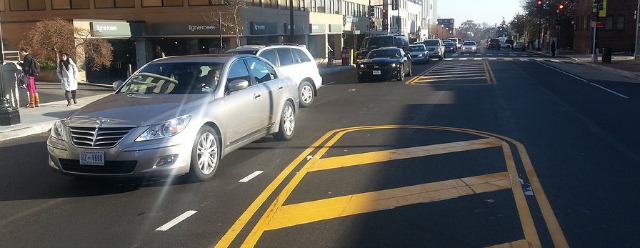 A third lane in Wisconsin Avenue in Glover Park has been turned into a median and dedicated left-turn lane. Photo by DDOT.
For years, Wisconsin Avenue from 34th Street in Glover Park to Massachusetts Avenue in Cathedral Heights had three lanes in both directions—a parking lane and two through-traffic lanes, the second of which doubled as a left-turn lane. But now some residents are complaining that newly configured lane patterns are causing traffic backups, especially through the heart of Glover Park.
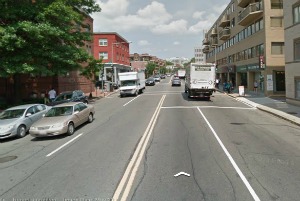 Old Wisconsin Avenue. Photo via Google Maps.
Late last year the D.C. Department of Transportation finished part of a $5 million streetscape project on that stretch of Wisconsin Avenue. Called a “road diet,” the project included turning one of the three lanes in each direction into a median and dedicated left-turn lane. (Just like before, the parking lanes on either side are opened to traffic during rush hour.)
According to plans that had been in the works since at least 2006, changing the function of that lane would make for safer driving—since cars making left-turns wouldn’t cause traffic to back up behind them, encouraging drivers to swerve into the right lane suddenly—and also lower speeds along the stretch, this making crossings safer for pedestrians.
But for some residents, the whole thing has just made Wisconsin Avenue a big pain in the ass to drive on.
“In my view, the change has caused traffic disruption, delays, increased vehicle emissions, harm to retailers, delays for vendors, and eventual and potentially higher costs for deliveries to the neighborhoods impacted. Side streets are now being utilized to avoid the traffic jams. The residents of those streets are already complaining that they desire ‘no through traffic.’ I am all in favor of smart growth and alternative methods of transportation. In this case, if we had metro access, the idea’s benefit might be a different story. But we don’t, so as a result anyone coming through North or South of Glover Park is forced to wait in long lines many times during the day. if the goal is to reduce resident families in favor of those without, it is working,” wrote one irate resident on a Georgetown email group.
There might be some truth to at least one of those complaints: according to a DDOT study conducted last year, during the construction on the road close to 3,000 cars a day chose to detour through Tunlaw Road and 37th Street NW, which run parallel to Wisconsin Avenue through a residential neighborhood.
But for supporters of the project, the entire idea is to slow traffic somewhat—cars used to speed up and down Wisconsin Avenue, they say, making pedestrians fearful to cross. As for the concerns that drivers will merely start taking side streets through residential roads, DDOT says it is now working on reconfiguring Tunlaw and 37th so that driving that route isn’t an attractive alternative.
Additionally, said DDOT spokesman John Lisle, engineers will conduct traffic counts when the project is complete to better assess if any changes need to be made, notably on traffic signals along Wisconsin Avenue.
The work taking place on Wisconsin Avenue is similar to other such projects that have taken place across the city to calm traffic and make pedestrian crossings safer. Similar designs have been used on 18th Street in Adams Morgan, Pennsylvania Avenue SE, Branch Avenue SE, and now Sherman Avenue NW, which is currently under construction.