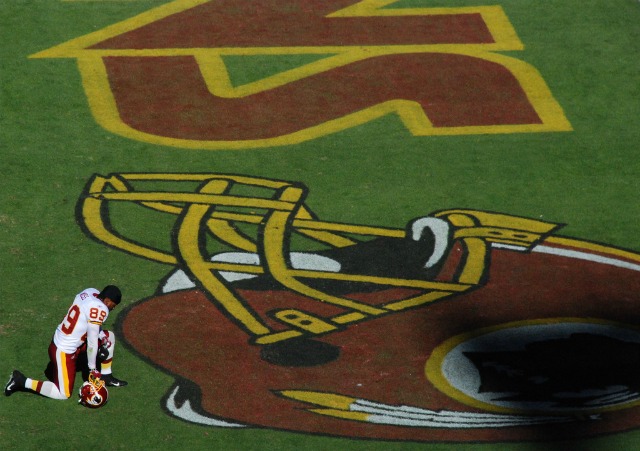
 Photo by mosley.brian
The logo, imagery, and full name of the Washington ‘Skins were the subjects of a daylong symposium at the Smithsonian’s National Museum of the American Indian yesterday. Panels of academics, activists, and journalists who cover the team discussed whether the time has come to drop a name that many consider blatantly racist, despite the fact that in 80 years, the team has shown no interest in switching.
Notably absent from the conference: any representative of the local NFL franchise.
Earlier panels discussed the broader issues of teams throughout the history of American sports appropriating Native American names and appearances, but throughout the day, panelists and audience members kept returning to the Washington football team.
The team’s name was the direct subject of the final panel, which featured Judge Judith Bartnoff of D.C. Superior Court; Erik Brady, a sports reporter for USA Today; the Rev. Graylan Hagler, the former president of Ministers for Racial, Social and Economic Justice; Robert Holden, deputy director of the National Congress of American Indians; and Mike Wise, a Washington Post sports columnist. All were unanimous in their feeling that a name change is long overdue.
Bartnoff recalled her experience attending the Washington Nationals’ playoff games last year, and joining in the thrill of more than 40,000 people chanting that team’s name. She said she does not attend NFL games because the thought of tens of thousands of people screaming out the Washington team’s name is unpalatable.
“I can only imagine what it would be with 90,000 people screaming a racial slur,” she said.
Brady ran through other sports teams that use Native American names—the Cleveland Indians, Atlanta Braves, Chicago Blackhawks, Kansas City Chiefs, to name a few—noting that while each of those franchises have their imperfections, the nicknames are not universally derogatory. Washington’s football team is the exception. “This one, except when applied to potatoes, always is,” Brady said.
Some media organizations—not Brady’s—have stopped using the full name of the Washington NFL franchise altogether. The Kansas City Star refers to the “Washington football team”; last year, Washington City Paper renamed the team the “Pigskins” in its pages; and DCist has started referring to the team simply by ‘Skins. An audience member asked how larger news organizations, such as the Post, can continue to write the name over and over again.
“We have not made it unacceptable,” Hagler said. “As long as folks wink and blink it will continue to exist.”
But looming more than fan familiarity, Wise said, is that there is no evidence the team has any financial incentive to change its name. Merchandise sales are strong, and even though the team’s current owner, Dan Snyder, purchased the trademark to “Washington Warriors” in 2005,” neither Snyder or any of his predecessors have ever suggested they plan to change the name simply because of political demand. Mayor Vince Gray said last month he believes changing the team’s name is worth a serious discussion, and on Tuesday during his State of the District address made several references to the franchise without actually uttering its name.
Those on the panel said that won’t be enough, though. Wise said it might take a player refusing to suit up in burgundy and gold unless a name change is in order. “If one athlete can kick Dan Snyder in the pocketbook, I believe he will begin to look at the issue differently,” he said.
Questions and comments offered by audience members suggested that the public desire is growing to see Washington’s football team shed a racially tinged legacy and adopt a new identity. Andre Holland, attending with his class from Anne Arundel Community College, said when he arrived at the museum yesterday wearing a team-branded cap, an older man of Native American descent asked if he might take the hat off and explained why the team’s imagery is offensive. The conversation had an impact.
“What would it be like if they were called the ‘Washington Niggers’?” Holland asked the room. “I would be offended.”
Yet an academic gathering, especially one in which the team declined to participate, might not have that much of a direct impact on the organization. A more public push for the franchise to rebrand itself could get underway soon at the Post, Wise said. Robert McCartney, a Metro columnist, wrote this week that after years of following the team without saying anything about its name, he’s decided to go public with his distaste:
OF COURSE the team should change the name. Duh. It’s the worst racial slur used as a team name in American sports. Dictionaries have labeled the word as “often offensive” at least since the 1970s.
The sports section, however, is a more difficult place to dance around a sports team’s name. Wise said that following his arrival from The New York Times in 2005, he spent his first year at the Post avoiding any direct mentions of the football team’s nickname. It didn’t last.
“The story became about me, and I would get all these emails saying, ‘You’re trying to spite us’,” Wise said. He added that while he enjoyed the reactions, he couldn’t continue being the lone Postie to evade the team’s name.
But Wise said that he might try to revisit the subject as soon as today, when the Post’s new executive editor, Martin Baron, holds a meeting with the sports department. “I will bring this issue up,” Wise said.