Martin Austermuhle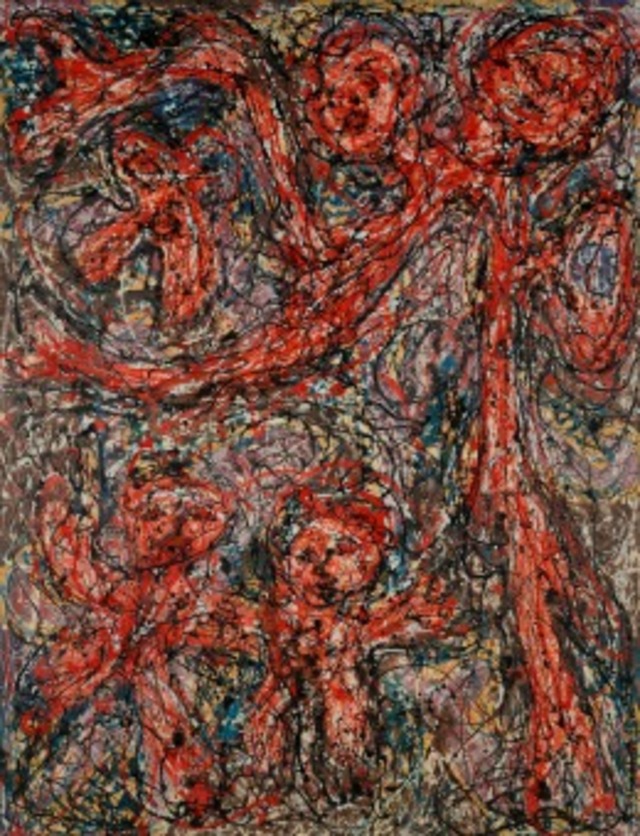
 Alfonso Ossorio, Red Family, 1951. Oil and enamel on canvas, 77 x 59 in. Dallas Museum of Art. General Acquisitions Fund and Theodore and Iva Hochstim Fund.
By DCist contributor Julia Langley
Sometimes exhibitions leave the viewer with more questions than answers, and that’s not necessarily a bad thing. Angels, Demons and Savages: Pollock, Ossorio, Dubuffet, now on view at the Phillips Collection, presents an opportunity to wonder about the relationships that nurture, support and promote creativity, as well as the paintings on view.
Angels, Demons and Savages sets out to investigate the relationship between three painters: American artist Jackson Pollock, French artist Jean Dubuffet and a lesser-known Philippine-born artist and collector named Alfonso Ossorio. Heir to a Philippine sugar fortune, Ossorio was a major collector of modern art and a highly capable artist in his own right. His ability to synthesize the abstract expressionist style of Pollock with Dubuffet’s art brut was not without success. The Phillips Collections takes a risk as it sets out to prove Ossorio’s work rises to the level of art world superstars Pollock and Dubuffet.
Ossorio, who left the Philippines as a young boy, spent his teen years at a boarding school in Rhode Island before entering Harvard University. He had his first one-man show in 1941 at Betty Parson’s Wakefield Gallery New York City. In 1949 Betty Parsons introduced Ossorio to Jackson Pollock. It was Pollock who recommended Ossorio meet Jean Dubuffet.
Through the years, Ossorio became a major collector of both artists, filling his estate in East Hampton, New York, with hundreds of their works, including Pollock’s famous painting, Lavender Mist (which Ossorio later sold to the National Gallery of Art). Photographs of Ossorio in his home show all three artists’ paintings, along with the work of other great abstractionists such as Clyfford Still. Ossorio had a great eye for art.
To understand Ossorio’s own style of painting, it is helpful to see his work in the context of Pollock and Dubuffet, both of whom he clearly admired. One of the works on view is Red Family, an Ossorio painting from 1951. Emerging and receding amongst the skeins of paint, red figures float into and out of view, gently testing the boundaries of the canvas. Two small, child-like figures stand near the bottom, while two ghostlike parental figures and angel appear to be drifting away above them. Both bright and sad, Red Family speaks to issues of familial love and loss.
Nearby, Dubuffet’s Corps de Dame — Chateau de’Etoupe and Pollock’s Lavender Mist suggest to the viewer how Ossorio was affected by his friendships with, and patronage of, these artists. Red Family combines the all-over painting style of Jackson Pollock with the primitivism of Jean Dubuffet. That’s all good, of course, because art doesn’t exist in a vacuum. Each artist takes something from one who went before. Pollock’s early work, for example, owed a great debt to his teacher, Thomas Hart Benton.
This, of course, is not a teacher/student relationship. Ossorio had his first exhibition at Parson’s Gallery before Pollock showed with Peggy Guggenheim and before Dubuffet quit working in business and gave his life over to making art. So Ossorio deserves to be seen on his own merit. What, then, is Ossorio’s artistic legacy? Can he stand on his own with these two giants of modern art? The question the Phillips Collection tempts us to ask is, would we be looking at Ossorio’s work if he hadn’t been such an important collector of Pollock and Dubuffet?
To prove Ossorio’s viability as an artist, one room of the exhibition is devoted to showing pieces he created for a major art project in the Philippines in 1950. Ossorio had been commissioned to create a mural for the Chapel of St. Joseph the Worker in the mill town of Victoria. It was the first time the artist had returned to the Philippines since he was eight years old.
It all sounds promising until one learns that the person who commissioned the work was Ossorio’s own brother, Frederick. The Chapel of St. Joseph was part of the Ossorio family factory complex. That the Phillips Collection doesn’t mention this anywhere in the exhibition is unfortunate because it brings forth some uncomfortable questions about why it may have chosen to highlight this particular artist who happens to have amassed an enormous and highly valuable collection of modern art before he died. One can’t help but wonder what will happen to those works of art down the road.
If Angels, Demons and Savages: Pollock, Ossorio, Dubuffet falls short in its bid to show Ossorio as a talent on par with Pollock and Dubuffet, it does succeed in another way—it shows that the world needs collectors. People like Ossorio are necessary to support artists and buy their work and lend their work and stimulate dialogue. Pollock and Dubuffet were great artists.
Ossorio was a good artist and a great collector. Isn’t that enough?