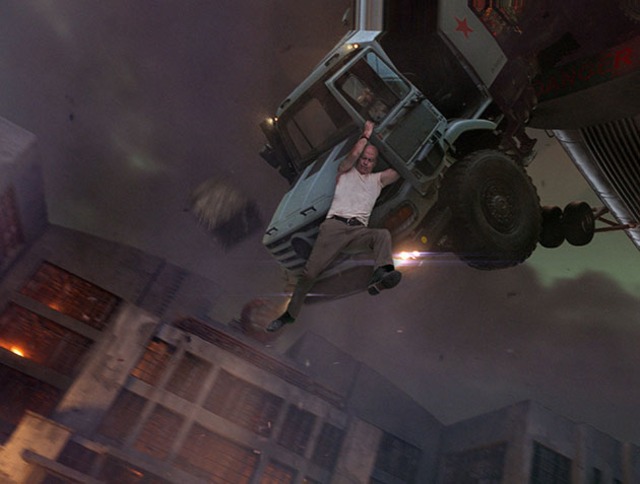
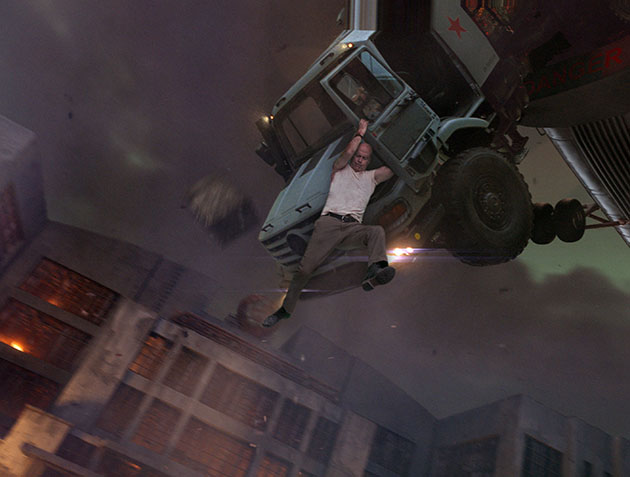
 John McClane keeps on truckin’. Really, that’s what the press caption says. (Twentieth Century Fox)
This week marks the return of two movie franchises whose films span decades of changing times and cultural mores. 56 Up and A Good Day to Die Hard don’t have much in common, but in their documentary and commercial fashion, episodes in the series reveal development, good or bad, in their leading performers. Whether it’s Neil Hughes, real life councilman, or John McClane, an ordinary man who finds himself in the wrong place at the right time. Director Michael Apted asserts that his Up films are about the heroism of daily life. The heroes we look for, in real life or at the movies, change over time.
The Die Hard movies come along more intermittently and span half the time of Michael Apted’s nearly fifty-year project. As the passing years add wrinkles and wisdom to the Up movies’ cross-section of a nation, so do the Die Hard films reveal erosion in our fictional heroes as well. In the case of A Good Day to Die Hard, it’s a long fall.
The problems with the fifth Die Hard movie begin as soon as the lights go down and the pre-credit exposition plays out—in Russia. From the first of the Die Hard movies, set in a high rise LA office building in 1988, to the cyber-anxious Washington, D.C. in which Live Free or Die Hard is set, the franchise anxiety has been homegrown. America’s skyscrapers, airways and subway tunnels were the playing fields for yesterday’s villains, and the producers of the first three Die Hard films could never have guessed the real horrors to come. Seen when they first came out, these movies beautifully choreographed ever more spectacular and frightening stunts. In retrospect, the stunts resonate in a different way, reminders of real life horrors, their heroics even more cathartic as they present an alternate reality in which we defeated enemy invaders. A Good Day to Die Hard largely keeps John McClane off American soil and removes the crucial homeland insecurity that drove the franchise from day one.
It gets worse.
The over-complicated plot, like the other films, pivots around a family crisis. A gunman kills a man in a Moscow nightclub. The assassin turns out to be McClane’s son (Jai Courtney), and pop hops a flight to Moscow to clean up after his son’s misdeeds. If that already sounds like a weaker setup than any of the other Die Hard films, you’re right. You don’t really feel Junior needs his father’s help, and you don’t really care if he gets it.
An action movie needs a good villain, and if Die Hard’s Alan Rickman has been unsurpassed in the series, the sequels had villains who still delivered a palpable threat. On paper, the Russian bad guys here may have had some promise: a tap-dancing thug-eating a carrot sounds like a great idea, but it falls completely flat. A movie this uninspired always begs for alternate casting ideas, and there’s one right under their noses. Character actor Cole Hauser has a too-brief role as Jai Courtney’s supervisor, but the sight of the Hauser name made me hope in vain for a cameo by his father Wings Hauser, one of the great B-movie hams of the 80s. Somebody hire him to play a Russian tap-dancing villain, stat!
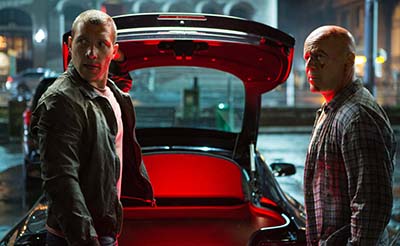 Jai Courtney and Bruce Willis share an aside about a trunk full of Chechen assault rifles to prolong the agony of a hopelessly inefficient script. (Frank Masi/Twentieth Century Fox)
A Good Day to Die Hard is a good half-hour shorter than any of the others, but it seems longer. The stunts aren’t even set up properly. Take one brilliant set piece from the often dismissed Live Free or Die Hard in which a car chase is resolved vertically with an exploding fire hydrant. The scene’s rhythmic editing never lets you lose sight of the big picture, action wise. But a Moscow car chase here is splattered with annoying quick-zoom shots, and resolved with a shot that comes out of nowhere. The big budget action movie can seem a mindless throw away craft, but the other Die Hard movies all set up stunts in a way that build maximum tension, a skill sorely lacking here. These stunts would have been better served by the Russian dashboard cams, whose meteorite footage is more exciting than anything on view here.
The first Die Hard worked so well because McClane was an underdog, an ordinary human with smarts and toughness and a sense of humor. He was the kind of American renegade you could root for. He became an arrogant hotshot in Die Hard 2, but Die Hard with a Vengeance and even Live Free or Die Hard still gave you a hero to root for and be worried about. Bruce Willis, who turned 57 just before shooting began, has become a better and more sensitive actor in the 25 years since the series began. Too bad the lines on his forehead are sharper and more expressive than anything in this movie.
—
Directed by John Moore
Written by Skip Woods
With Bruce Willis, Jai Courtney, Mary Elizabeth Winstead
Running time: a very long 97 minutes.
Rated R for violence and language.