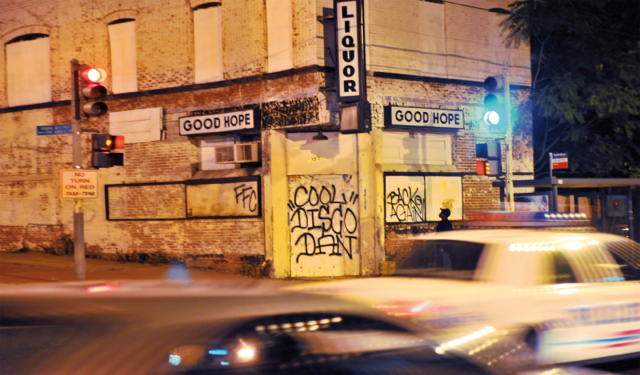
 Cool ‘Disco’ Dan at Good Hope Road, Southeast Washington, 2008. Photo by Rosina Teri Memolo. Collection of Roger Gastman
By DCist contributing writer Matt Cohen
These days, reflecting on D.C. counterculture in the 1980s almost always digresses into a mediation on the birth of hardcore punk. That’s due in part to the sheer amount of punk documentaries and books about the city’s hardcore. The fact of the matter is that there was a whole lot more going on in the District than a gaggle of frustrated teenagers moshing to aggressively kinetic music during that time. If you lived in D.C. through the 80s and early 90s, chances are the words Cool “Disco” Dan mean as much to you as the phrase “BYT-sponsored party” does to any contemporary mid-20s gentrifier.
A film 10 years-in-the-making, Joseph Pattisall and Roger Gastman’s The Legend of “Cool” Disco Dan is a glossy and thorough, albeit hurried, look at the life of “urban phantom” Dan Hogg. Compiling an impressive amount of archival footage, newspaper clips, and photographs from Chocolate City’s go-go days, the film traces the origins of the infamous tagger and the cultural mark he’s left on the city.
Cool “Disco” Dan’s graffiti tag—the non-descript go-go lettering of his name, complete with the irreverent quotations hugging the “Disco” midriff—is about as iconic of the era as then-Mayor Marion Barry’s utterance, “Bitch set me up.” During Dan’s most prolific period, the tag could be found in almost every block of D.C.: overpasses, walls, Metro tunnels, even the sides of Metro buses. The fact that little was known about who “Disco” Dan was or why he was so cool only added to the intrigue and mystery surrounding his mark. That was until The Washington Post’s Paul Hendrickson managed to track him down and revealed his identity in an illuminating 1991 profile. But at that point, Dan had already become so much of an icon, that his anonymity was irrelevant. At a time when the city was suffering from a major crack epidemic, the Cool “Disco” Dan tag was seen as a sort of symbol of hope for the city.
Narrated by Henry Rollins, the film fuses an impressive cast of interview subjects that includes Hendrickson himself, along with an array of legendary Washingtonians—Barry, Ian MacKaye, Chuck Brown, and more. But the real strength of Pattisall and Gastman’s film isn’t so much in profiling the enigmatic graffiti artist as it is in chronicling the city’s most culturally prolific, yet socially fractured time.
The Legend of “Cool” Disco Dan is as much Dan’s story as it is a portrait of the often-overlooked African-American culture of 1980s D.C. Pattisall and Gastman frame Dan’s life against the booming Go-Go scene and the birth of neighborhood street crews like the “A-Team,” “Gangster Chronicles,” and “Minnesota Avenue Crew”. As Dan’s story is told—a shy, quiet child who learned to harness his frustrations and anxieties through art—we’re also told the story of how D.C.’s culture was quickly engulfed and overtaken by the rise of crack-cocaine: People stopped going to go-go shows; street crews evolved from a group of graffiti-tagging misfits into lethal drug-dealing gangs; and a once-vibrant community became a shell of what it used to be.
Throughout D.C.’s darkest days, however, Dan was going through his own problems: Some psychological issues often alienated Dan from his family, and he periodically found himself out on the street. But, he never succombed to the crack problem and always remained clean and sober. As Rollins says in the film’s closing minutes, Cool “Disco” Dan was something of “a symbol of survival during D.C.’s most trying years,” and this film—while messy and meandering at times—manages to chronicle those trying years as thoroughly as possible, without ever coming off as anything but authentic.
The Legend of Cool “Disco” Dan screens Saturday and Monday at the AFI Silver Theatre (8633 Colesville Road, Silver Spring). Saturday shows sold out; Monday at 9:45 p.m., tickets $11.50.