
For all of The Washington Post’s laurels, the layout, efficiency, and modernity of its website are not among them. Too often, it seems as though feature stories that could be dynamic on a computer screen are slow and static.
This week, though, the Post is trying something new: A feature story about Joe Dombrowski, a 21-year-old cyclist from Northern Virginia who is currently training in France with one of the top teams in the world. The profile, written by Rick Maese, analyzes Dombrowski as professional cycling’s great young hope of rehabilitating the sport’s image in the wake of the very public downfall of Lance Armstrong. (DCist also profiled Dombrowski in January.)
But unlike an ordinary Post feature in which the online version would be spread across five or six pages accompanied by an ad-supported slideshow and perhaps a quick video, Maese’s story is the debut of a new storytelling platform developed at 15th and L. “Cycling’s Road Forward,” as it is titled, unfolds on a single page with full-width photos, videos, and interactive data-driven graphics built directly into the text. The different media complement, not rival, each other for the reader’s attention, and the entire package scrolls with ease. In other words, it’s a flash of modernity on a website that has plenty of user experience faults.
Much of the design was handled by Wilson Andrews, an interactive designer in the Post’s graphics department. The paper’s web team had been workshopping the new template for a while, and jumped at the opportunity to use a sports feature as a “proof-of-concept.” The sports desk approached Andrews and his team on January 9, just as Maese was headed off to Nice to meet up with Dombrowski.
“We kind of had this idea there was a local kids who is considered one of the young greats,” Andrews says. “We had really good access, his team was really welcoming. We were able to use his data from one of his training rides.”
That data, about four-fifths of the way down in the online version, shows mile-by-mile readings of Dombrowski’s heart rate, speed, cadence, and watts generated over the course of an 80-mile ride along a mountain ridge between Nice and Monaco. The data module also includes audio snippets of Dombrowski describing each stage.
Though Post employees hesitate to admit it, the obvious comparison to “Cycling’s Road Forward” is The New York Times’ “Snow Fall” feature last December. That package, rolled out over the course of several days, combined text, video, data, and photography to retell the story of a group of skiers caught in an avalanche in the Cascade Mountains. “Snow Fall,” in addition to telling a gripping story, was also lauded for its innovative—for a major metropolitan broadsheet’s website—and seamless combination of multimedia.
“I would be lying to say we didn’t notice they did that,” Andrews says. “I would be lying to say we didn’t notice they did that.” Still, he calls the Times’ product a “great example” of where the digital presentation of feature stories could be headed.
Mitch Rubin, the Post’s sports production editor, puts more distance between the Dombrowski feature and what the Times produced. “From reports the Times spent a lot of time doing ‘Snow Fall’,” he says. “We didn’t have that much time.”
Maese started working on a profile of Dombrowksi last December, when the cyclist was still at home in Virginia. A.J. Chavar, a Post videographer, also shot video of Dombrowski training stateside that appears in the package.
“At that point I thought it would be one of our enterprise pieces with great reporting, nice photos, nice video,” Rubin says. But then came the prospect of being able to incorporate Dombrowski’s ride data.
“A little light bulb went off in terms of data,” he continues. “The idea of following his training ride almost in real time where we’d have a camera on him and data from his ride and a map where it would be almost video-game-like.”
The online edition of the story also features video shot in France by Maese, who used a GoPro camera to track Dombrowksi’s rides.
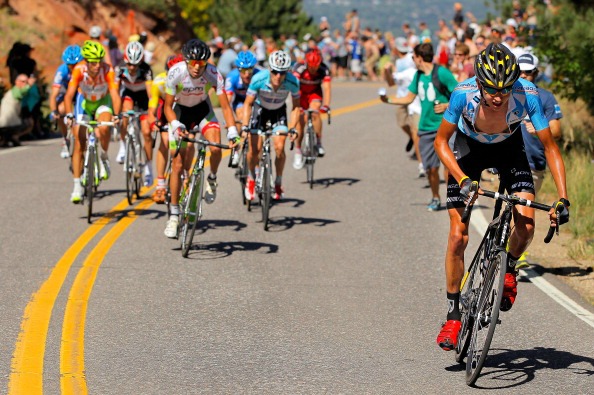 Dombrowski, riding for Bontrager-Livestrong, attacked the group of the yellow jersey on the climb of Flagstaff Mountain as he defended the best young rider’s jersey in stage six of the USA Pro Challenge from Golden to Boulder on August 25, 2012 in Boulder, Colorado. (Photo by Doug Pensinger/Getty Images)
The story started coming to the digital team by early February, Andrews says. Working off an outline from Maese, Andrews and his colleagues started building a “wireframe” of how the package would appear. The template itself is built on Bootstrap, a free Javascript platform developed by Twitter that allows for easier integration of graphics, charts, and other visual items into a text-heavy item. The platform is also designed to work equally well on desktops as it is mobile devices.
Rubin describes getting his superiors—up to Managing Editor John Temple—to sign off on this production as a “medium sell” because of the amount of resources required. Andrews’ team, which is utilized by many editorial departments, devoted several weeks to “Cycling’s Road Forward.” For the most part, they’re pleased with how it turned out online.
“We have the raw materials,” Rubin says. “It’s pretty. We have good visuals. We have the data. And we have a really good story underneath it by Rick. Based on early analytics people are spending a long time on the story. They’re happy it looks great on mobile. It’s not this runaway superstar hit where we’re getting hundreds of thousands [of clicks].”
For Andrews, the Dombrowski story is a chance to move the Post’s often stodgy website forward. And an evergreen sports story was a good test subject. “I think everybody’s been waiting for the opportunity to do something like this,” he says. “There’s not a lot of people shuffling for a cycling story. Our first one was to show people with an easier story.”
As for the dead-tree version? That’s coming out Sunday and is scheduled to run on A1. Rubin says the layout will be as engaging as print can possibly be, though obviously it won’t have any moving parts.