 Getty Images
The Maryland House of Delegates voted today to overturn the state’s death penalty, clearing the way for Gov. Martin O’Malley to sign the repeal into law. Legislators voted by a margin of 82 to 56 in favor of getting rid of capital punishment. The Maryland Senate voted last week to repeal the death penalty.
Under the terms of the bill adopted today, life in prison without the possibility of parole will be the most severe criminal penalty.
Although Maryland has not executed a death row prisoner since 2005, capital punishment has been on its books since its founding as a British colony in 1689. The state currently has five inmates sentenced to death, but since taking office in 2007, O’Malley’s administration has practiced an effective moratorium.
Today’s vote also represents a significant political victory for O’Malley, who is frequently mentioned as a possible candidate for the Democratic Party’s presidential nomination in 2016. With O’Malley’s signature on the bill, Maryland will become the sixth state in as many years to overturn capital punishment. O’Malley last pushed to repeal the death penalty in 2009, but that effort was stopped short and replaced by reforms to how the punishment is applied.
O’Malley was backed in this effort by several major anti-capital punishment advocates. He testified last month before the Maryland Senate alongside Archbishop William E. Lori of the Roman Catholic Archdiocese of Baltimore and representatives from the NAACP. The organization’s president, Benjamin Jealous, applauded the House of Delegates’ vote in a news release today.
“Tomorrow we will wake up in a state where we will never again have to worry if someone is put to death because of their color, class or in spite of their innocence,” Jealous said.
With the addition of Maryland, 18 states and the District of Columbia will not have the death penalty.
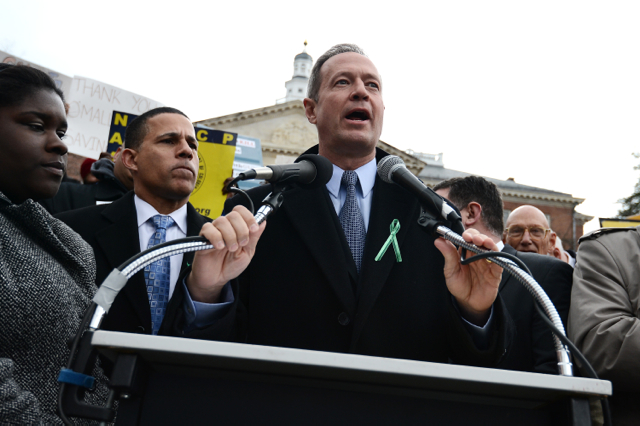
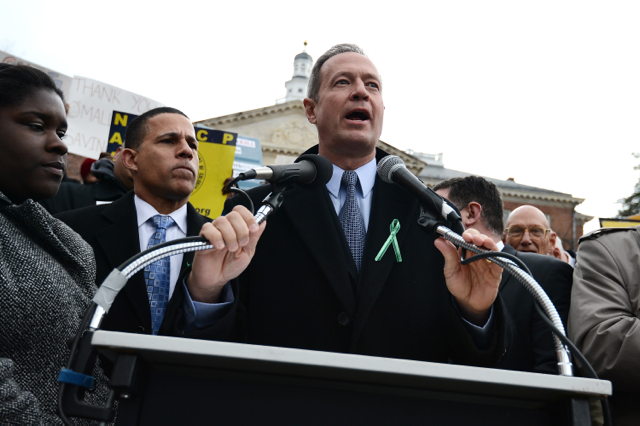
“We have a moral responsibility to not do the things that are wasteful,” O’Malley said at a press conference celebrating the vote. “It removes Maryland from the ranks of other places in this world like Iraq, Iran, and North Korea that still have public executions.”
Lt. Gov. Anthony Brown followed O’Malley, noting the historic unevenness with which capital punishment was applied. “The death penalty system was broken and it was impossible to rid itself of its flaws,” he said.