Martin Austermuhle
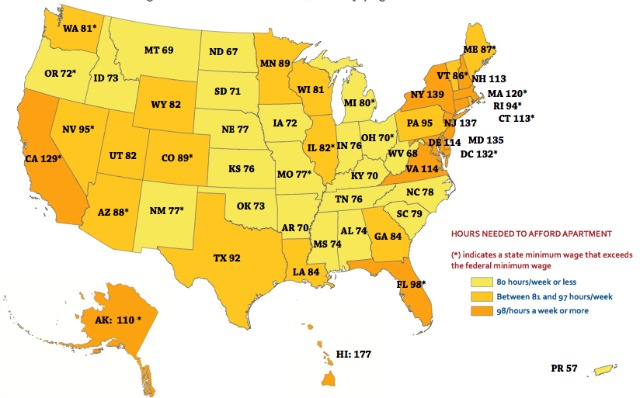 A map showing the number of hours a minimum wage worker would have to toil per week to be able to afford the rent on a two-bedroom apartment.
Everyone knows that D.C. is an expensive rental market, and affordable housing options are scarce. But just how hard would someone at the bottom have to work to afford a two-bedroom apartment within city limits?
A lot. One-hundred-thirty-two hours a lot, to be exact. That’s what a new report from the National Low-Income Housing Coalition has found, determining that someone making minimum wage in D.C. would have to work just about every waking hour in a week to afford what average D.C. rents demand on a two-bedroom place. Or, to put it another way, D.C. workers have to make at least $27.15 per hour so as to afford the average two-bedroom rental cost of $1,412 while keeping something close to a 40-hour work week. Here’s the full breakdown for D.C.:
In the District of Columbia, the Fair Market Rent (FMR) for a two-bedroom apartment is $1,412. In order to afford this level of rent and utilities – without paying more than 30% of income on housing – a household must earn $4,707 monthly or $56,480 annually. Assuming a 40-hour work week, 52 weeks per year, this level of income translates into a Housing Wage of $27.15.
In the District of Columbia, a minimum wage worker earns an hourly wage of $8.25. In order to afford the FMR for a two-bedroom apartment, a minimum wage earner must work 132 hours per week, 52 weeks per year. Or a household must include 3.3 minimum wage earners working 40 hours per week year-round in order to make the two-bedroom FMR affordable.
In the District of Columbia, the estimated mean (average) wage for a renter is $25.20. In order to afford the FMR for a two-bedroom apartment at this wage, a renter must work 43 hours per week, 52 weeks per year. Or, working 40 hours per week year-round, a household must include 1.1 workers earning the mean renter wage in order to make the two-bedroom FMR affordable.
So how does D.C. stack up compared to other metro areas? It’s cheaper. Honolulu leads the charge with an hourly housing wage of just over $35, followed by a smattering of counties in and around Silicon Valley and New York City. (D.C. falls just outside the top 10.) As for the states, Hawaii is again tops at $32.14, followed by California and New York. Maryland ranks fifth at $24.47, while Virginia is ninth at $20.72. All told, the report finds that nowhere in the U.S. can a minimum wage worker toiling for a standard week afford the rent for a two-bedroom home.
Mayor Vince Gray has pledged to put $100 million into building or sustaining 10,000 units of affordable housing in the city, but even housing advocates say that it’s simply not enough. Thankfully, with the glut of apartments hitting the market, rents might be on the way down.