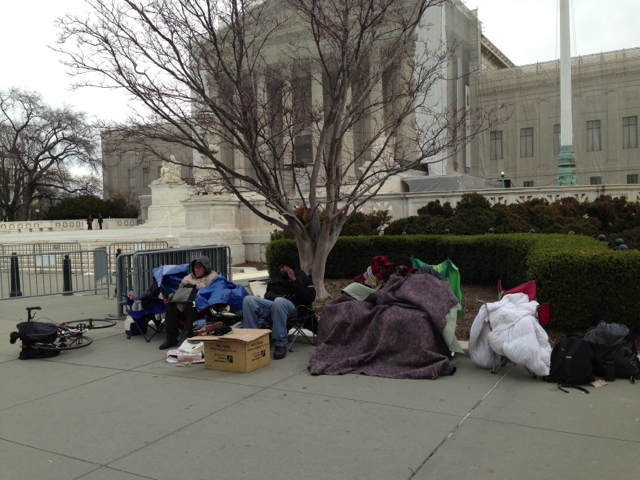
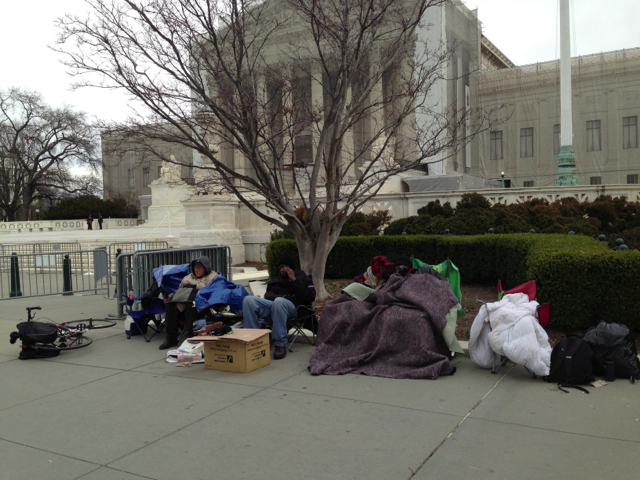
 Photo by Benjamin R. Freed
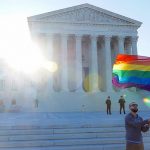
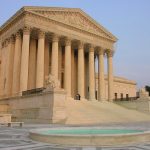
The first person in line outside the U.S. Supreme Court gives his name only as Rick, but he’s been camping out there since last Thursday. Rick, a courier in his mid-50s, will be No. 1 in the queue Tuesday morning for the small parcel of public admissions to watch oral arguments in Hollingsworth v. Perry, better known as the case in which the justices will once and for all decide if Proposition 8, California’s 2008 law prohibiting same-sex marriage, is unconstitutional.
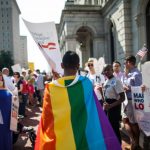
The forty or so court-watchers sit with bundles of food, blankets, and tarpaulins up against the fence around the court, nearly reaching the corner of First and East Capitol streets NE. A Supreme Court Police officer says he expects the line to get much longer by Tuesday morning, in spite of the frosty forecasts projected for the early part of the week.
Rick, clutching a clipboard with a semi-official roster of who’s in which spot in the line, is bundled in a beige parka with the hood pulled over a New York Yankees cap. Like everyone else huddled around the court on Sunday afternoon, he is a supporter of marriage equality. In fact, he hasn’t seen anyone from the opposition yet.
“If the country’s split 50-50, where’s the other side?” Rick asks. National support for gay marriage is actually doing better than an even split among public opinion. A poll released last week by ABC News and The Washington Post reports that 58 percent of Americans support allowing same-sex marriage.
Still, the naysayers are expected. Another court camper says he’s heard Westboro Baptist Church, the Topeka, Kan. fringe group, will be marching out its zealots.
“That should be fun,” Rick says.
Farther down, three people who met in the queue are trying to erect a makeshift lean-to from their blankets and tarps. Jason Wonacott, who arrived Friday, and Jessica Skrebis, who showed up Saturday, did not know each other before lining up for these court-side seats.
Wonacott, who moved to D.C. a few years ago from San Francisco, was still a California resident when voters there passed Proposition 8 and put an end to that state’s year of granting marriage licenses to same-sex couples. “I was at my uncle’s wedding in Los Angeles a month before the election,” Wonacott recalls. “When we lost it was a very sinking feeling.”
Now, Wonacott says he is taking a few days off so he can have a shot at “witnessing history.” That he enjoys full marriage equality as a D.C. resident is beside the point. “I’d like ot get married wherever I’d like, anywhere in the U.S.,” he says.
Skrebis and Wonacott are joined by Jeffrey De Soto, who traveled down from New York in hopes of getting tickets to the arguments in Hollingsworth v. Perry and Wednesday’s case, United States v. Windsor, which will test the constitutionality of the Defense of Marriage Act, or DOMA, a 1996 federal statute defining marriage as the union of one man and one woman.
As De Soto returns from lunch, Skrebis and Wonacott are putting the finishing touches on their makeshift shelter, pulling an un-pitched tent sheet over a tarp and propped up by a tailgate chair. But they soon have to disassemble it, when the police officer minding the line reminds them and other queuers that although they are welcome to camp outside the Supreme Court, temporary structures are prohibited. (The order is received quite peacefully, even by some campers who put in time at a rebellious campsite on government property.)
“I’m a little worried about the weather,” De Soto, outfitted in a blue ski jacket, says after warning his new friends that wintry weather is imminent. (It actually won’t begin for a few more hours.)
But taking a few days off from his job as a software engineer is worth a few chilly nights to De Soto if it means he gets to watch the justices hear the cases against Proposition 8 and DOMA. “I’ve sort of always wanted to watch oral arguments at the Supreme Court,” he says. “And its very important as a gay man.”
Of course, the people lined up now and the ones who will join them over the next few days are only waiting for the arguments. It’ll be a few more months before the court hands down its rulings. De Soto anticipates that if the justices strike down Proposition 8 or DOMA or both, it’ll be a sensation similar to the one he experienced in June 2011 when New York State legalized same-sex marriage and De Soto and his friends poured into the streets of Manhattan to celebrate.
Wonacott is optimistic about the cases, too, at least when he reads into the way people vote today. He notes that only six months passed between last May, when North Carolina residents adopted a state constitutional amendement banning same-sex marriage, and Election Day, when voters three states—Maryland, Maine, and Washington—approved marriage equality and voters in Minnesota defeated an anti-marriage equality amendment.
“Public opinion is changing so fast,” he says.
That will have to keep Wonacott and the others warm for a while longer. It’s snowing today, and the forecasted high is a grim, un-springlike 39 degrees.