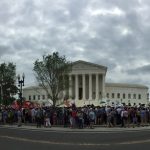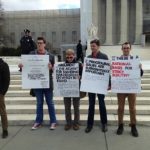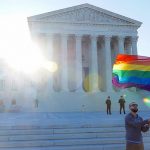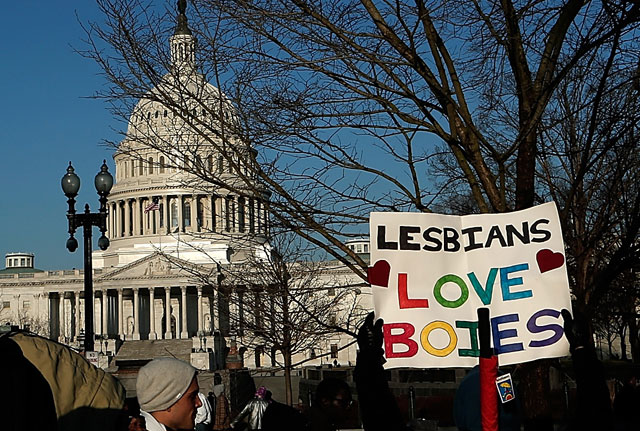
Thousands of supporters and opponents of same-sex marriage held dueling rallies outside the steps of the U.S. Supreme Court today while inside, justices heard the oral arguments in one of the most anticipated cases in recent memory. With the court deliberating the fate of California Proposition 8, a 2008 ballot referendum that banned same-sex marriage in that state, people from around the country clamored in support of their beliefs, though the backers of marriage equality far outnumbered the detractors.
“It was serendipitous,” Jodi Denney, a firefighter from Seattle, said about her attendance at a demonstration this morning that featured speeches from more than a dozen same-sex marriage advocates. “I came to remind people that I’m here.”
Denney, who was dressed in her formal, navy blue Seattle Fire Department uniform, held a sign reading, “I protect your family. Protect mine.”
Stuart Gaffney and John Lewis, a couple from San Francisco, said they had been standing outside the court since last night wearing the tuxedos they wore at their 2008 wedding. Gaffney also held a heart-shaped sign reading “Stuart + John, 25 years,” in reference to how long they have been together.
“There’s no where else in the world we’d rather be,” Gaffney said. “We’re legally married in California, but we’re Americans. We should have rights coast to coast.”
Gaffney said November 4, 2008, when California residents voted to put a stop to the same-sex marriages that had been conducted for nearly a year, as “one of the hardest days.”
Taking up the entire sidewalk between Constitution Avenue and East Capitol Street NE, thousands more marriage equality proponents chanted and hoisted signs provided by groups such as Human Rights Campaign, the American Foundation for Equal Rights, and other organizations. Among the speakers at the rally were Del. Eleanor Holmes Norton (D-D.C.); the Very Rev. Gary Hall, dean of the Washington National Cathedral; Brendon Ayanbadejo, a Baltimore Ravens linebacker; and Bishop Gene Robinson, the former head of the Episcopalian Diocese of New Hampshire and the first openly gay bishop in a major Christian religion.
“For too long we’ve let the religious right hold the bible hostage,” Robinson told the crowd. “God is love and where love is God is.”
But across the street, on the East Lawn of the U.S. Capitol, opponents of same-sex marriage were just as vociferous, if not as plentiful. “Gay rights will never be civil rights,” Carl Boyd Jr., a conservative radio host from Nashville, Tenn., told a group of demonstrators brought out by groups like the National Organization for Marriage.
“The Bible calls homosexuality an abomination,” Boyd said. “Two hairy men having sex together—think about it. Wait, don’t think about it.”
Boyd said he came from Tennessee with members of the Coalition of African-American Pastors, a clergy group that has loudly opposed same-sex marriage. “When you deal with civil rights you were dealign with American equality,” Boyd said in an interview. “It’s not the same. Gay people can eat in the same restaurants, gay people can vote.”
Carl Boyd Jr., same-sex marriage opponent
Back on the Supreme Court side of the street, though, the supporters of marriage equality were unfazed by the counter-demonstration. In an interview, Ayanbadejo compared the Proposition 8 case, Hollingsworth v. Perry, to the Supreme Court’s landmark 1967 decision in Loving v. Virginia, which struck down laws prohibiting mixed-ethnicity marriages.
“Today is a monumental day,” Ayanbadejo said. “They told us we can’t do it in the ’60s, and its 2013 and believe it or not they’re still telling us who we can’t love.”
Ayanbadejo also addressed a column published in The New York Times last Sunday by his fellow NFL player, Scott Fujita, who wrote about his support for marriage equality. The Ravens linebacker, who has long supported same-sex marriage and filed a brief in support of the case to overturn Proposition 8, said he believes the National Football League is ready to embrace an openly gay player.
“This is also an equal rights issue,” he said. “We’re trying to change not just a few people but change the whole culture. The NFL is ready.”
Ayanbadejo, coming off the Ravens’ Super Bowl-championship season, also said a decision striking down Proposition 8 would be even more gratifying than besting the rest of the NFL.
“A Super Bowl win is the eptome of a career,” he said. “This is a completely different realm, but it will be more exciting when LGBT rights are granted nationally and everyone can marry who they love. That’ll be probably one of the most momentous days of my life—other than the birth of my children.”
Chad Griffin, the president of Human Rights Campaign, was inside the Supreme Court for the hearing. He walked out optimistic that the justices would be swayed by the arguments they heard from Theodore Olson, a former solicitor general in the George W. Bush administration who is the lead attorney in the case to strike down Proposition 8.
“Four years later from when we started this journey, this case was heard before the highest court in the land,” Griffin said on the Supreme Court steps. “Those plaintiffs—two couples from California—”and that lawyer is the best we can have representing us.”
Griffin said that the justices asked “probing and tough questions” of both sides in the case, but that Olson “brilliantly articulated” why same-sex marriage is constitutional.
“First of all there is a fundamental constitutional right to marry, as this court has found on 14 separate occasions,” Griffin said. “Second, by denying them like in California, it does grave harm to them and their families. And third, by granting that right, it harms absolutely no one. And for those reasons, I hope very soon Proposition 8 will be erased from the books once and for all.”
Early analyses by Supreme Court watchers suggested that the if justices rule in favor of marriage equality, they would do so in a narrow manner that only affects California. Griffin said it is way too soon to make that reading.
“I would refer you to the early analysis around the health care case,” he said. “And virtually all of the analyzers were wrong, and for those reasons its a mistake to try to read anything into the questions that were asked by these justices. I’ve been cautiously optimistic about this case since the day we filed it, and my optimism comes from the fact that, as evidenced again by trial, the law and the facts and the evidence are on our side.”
As for the scene outside the court, Griffin said the presence of thousands of demonstrators bolstered his cautious optimism. “What I saw is families—many loving families—who were here with their kids, with smiles on their faces, and with hope,” he said. “Hope that this court will go as the lower courts have gone and strike down Proposition 8 once and for all.”