Martin Austermuhle
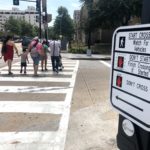
There are plenty of D.C. roads where pedestrians dart from one side to another, despite there not being an official crosswalk. There are also places where a crosswalk exists, but it’s not attached to a traffic signal, meaning that pedestrians have to hope that oncoming traffic decides to stop.
But now D.C. is in the process of installing a number of special pedestrian crossing signals where traffic is warned to slow and stop when a pedestrian is present but can proceed through after they’re gone.
NBC4 reported yesterday that one of the new signals, known as a HAWK (High-Intensity Activated Crosswalk), is going up on Connecticut Avenue halfway between Newark and Ordway Streets in Cleveland Park. Once that signal is fully operational, a pedestrian—who can now only cross at Newark or Ordway—will be able to press a button that will trigger three lights that warn cars to stop. After the pedestrian makes it across the lanes, cars can proceed forward.
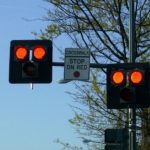
Another HAWK is already in use at 16th and Jonquil Streets NW, where there’s a crosswalk but no traffic light. That HAWK senses when a pedestrian wants to cross, triggering the lights, which go from flashing yellow to solid yellow to solid red to blinking red. (See the brochure below for a full explanation.)
Five of the HAWK signals will be in operation soon; the next one is going in at Minnesota Avenue and C Street NE. City officials chose locations based on past accidents. The Cleveland Park location makes sense—you can stand on the sidewalk on any given day and watch people dart across the road instead of walking to either of the traffic lights, which are roughly 1,000 feet apart.
Skeptical? Don’t be. A 2010 study of HAWK crossings in Tuscon by the Federal Highway Administration found that they really do work—there was a 69 percent reduction in pedestrian crashes at the locations that use the new signal. D.C. actually ran a pilot on Georgia Avenue and Hemlock Street NW in 2009, where it showed a 97.1 percent motorist compliance rate with the signal.
At the time, though, D.C. officials found that one challenge would have to be overcome: pedestrian and driver habits. Some pedestrians didn’t activate the signal at all, a report found, while others would activate it and cross immediately, not allowing motorists to respond to the changing lights. Motorists were also somewhat confused, with some not realizing that they could proceed forward during the blinking red cycle (after the pedestrian has crossed their lanes of traffic).
In D.C., cars have to stop for pedestrians in a crosswalk. The law was recently tweaked so that cars can proceed after a pedestrian has made it across their lanes; as the law was written before, it would technically be a violation for a car to move through a crosswalk if a pedestrian was in it but on the opposite side of the street.