 (Adopt Films)
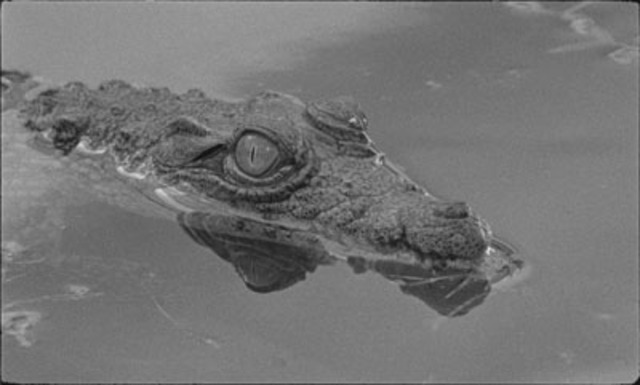
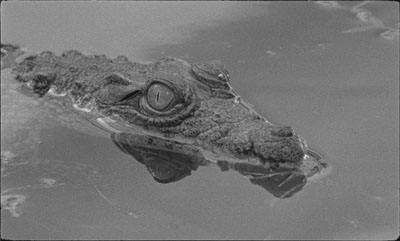
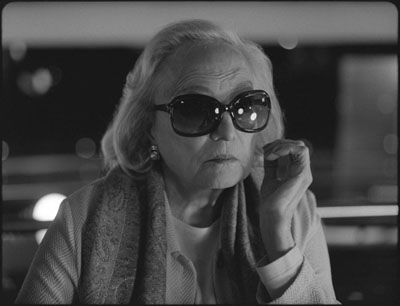
There are two big-eyed supporting characters who walk away with Miguel Gomes’ film Tabu. One is dotty dowager Aurora, peering elegantly from behind Swifty Lazar shades. The other is a crocodile.
Aurora (Laura Soveral) is prone to gambling—“Lucky at gambling, unlucky at love,” she hears in a dream that sends her running to her local casino. Her neighbor Pilar (Teresa Madruga), a newly retired woman, comes to the rescue when Aurora runs out of money and can’t get back home. The neighbors sit on a revolving platform as Aurora tells Pilar her dream about a monkey husband. Tabu takes time to reveal its mysteries, but when Laura Soveral and her giant sunglasses and hairy dreams appear about ten minutes into the film, it had me for the duration.
The movie begins with a touch of magical realism. A Portuguese explorer wanders around Africa trying to forget his late wife. She appears to him in a vision, and after the inconsolable husband welcomes death in a crocodile-infested river, legend has it that those who walk the area at night may see a sad crocodile hanging out by the riverside with a strangely dressed woman. The role of crocodiles in the film expands on the expressive “performance” of native reptiles in Werner Herzog’s Bad Lieutenant: Port of Call New Orleans. In Herzog’s film, reptiles came to represent Nicolas Cage’s tenuous grip on reality. Here the toothy scene-stealers are a Herzoggian reminder of nature and mortality that is part of a well-crafted cinematic reality.
The piano score by Joana Sá that launches Tabu sets the tone of an old-fashioned black and white movie. Inspired by F.W. Murnau’s 1931 film Tabu: A Story of the South Seas, Gomes’ film is, like Murnau’s, split into chapters called “Paradise” and “Paradise Lost.” Gomes’ Paradise is an irretrievable past, but not an entirely innocent one, and time shifts in subtle ways. The opening phrase of Sa’s music sounds like it could at any second launch into the Stones “Monkey Man”, foreshadowing Aurora’s dream and maybe even a colonialist mentality.
 Laura Soveral (Adopt Films)
The elderly Aurora is the lifeblood of Paradise Lost, but she harbors memories of a troubled Paradise. This Paradise plays out under the narration of Aurora’s old friend Ventura, and although we watch these figures from their past speak, I’d like to think we only hear their voices when they’re singing. This emphasizes that the stories we tell separate us from Paradise, and this distance keeps the sordid tale of love and betrayal in Africa from coming off as mere melodrama. We can only experience this Paradise in stories and music, and these $mdash; memory, art — naturally change the nature of the idyllic land. The pop group that forms in Paradise becomes yet another layer of storytelling, an act of nostalgia filtered through an unexpected voice, incongruous but fitting perfectly with the movie’s playful tone. Tabu suggests that colonialism is yet another story, but the fate of Aurora and Ventura shows that they are not exactly victors.
At its heart, the movie is about a doomed love triangle out of Aurora’s past, but the triangle is also in the three-part manner in which the movie unfolds. By design, the vision of Paradise isn’t as interesting as that of Paradise Lost. The silent movie homage of the film’s second half requires actors with expressive faces and commanding prescence, and while the male actors do alright by this standard, the actress playing the young Aurora, Ana Moreira, pales in comparison to the vivid Soveral. This shortcoming suits the tale of an eccentric neighbor whose life held a lot of secrets. Tabu shifts in and out of storytelling angles but holds on to its black and white palette for its entire length. All the stories we tell, realistic or heightened by romance, are still stories, filtered through the lenses we carry inside us.
—
Tabu
Directed by Miguel Gomes
Written by Miguel Gomes and Mariana Ricardo
With Teresea Madruga, Laura Soveral, Ana Moreira, Carlotto Cotta, Isabel Cardoso
Not rated: contains violence, sexual situations and nudity.
Running time 118 minutes