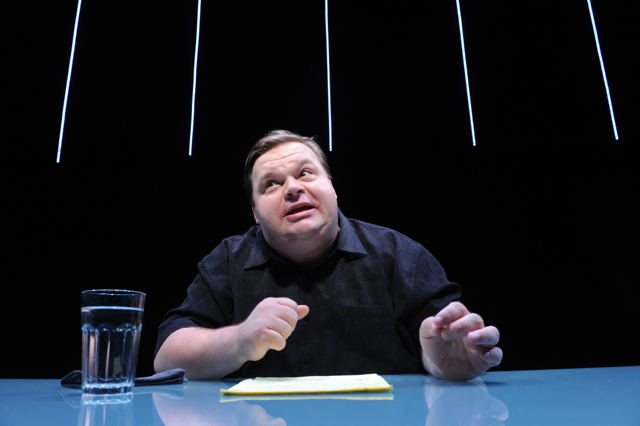
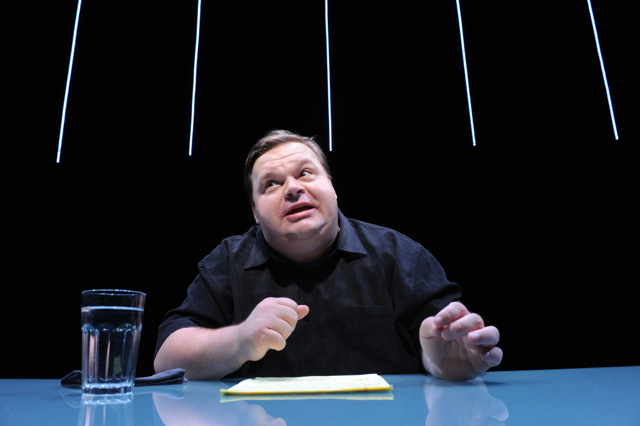
 Daisey (Woolly Mammoth Theatre Company/Stan Barouh)
We, the audience, are out on the sidewalk to watch Mike Daisey finish his more than two-hour monologue, American Utopias. Gathered outside this high-end Mexican restaurant next to Woolly Mammoth, this teeming mash of ears and eyeballs strains for his final words… and for 10 minutes, this downtown D.C. sidewalk is a human fortress, inviting quizzical glances and extra-surly cigarette puffs from Friday night revelers who want to get through.
The above paragraph is how I imagine a draft of Mike Daisey’s review of his own show might read … if it was written by a ghost of himself on, say, less sleep.
It’s hard for the man’s narrative not to seep into your subconscious. Not the least because, as mentioned, it is a more-than-two-hour monologue—which he delivers seated in the center front part of the stage, behind a table with a pile of papers containing notes, which he barely looks at, ostensibly on each of the three interwoven stories he’s giving us on Walt Disney World, Burning Man and the Occupy movement. The only other prop is a small napkin, which he uses to mop up the pools of sweat forming on his brow.
Like Woody Allen, Louis C.K., and Jonathan Ames, Daisey is part of the great comedic tradition of the sensitive, awkward white men possessed, importantly, with the rare talent of sculpting funny out of acute self-awareness/loathing and discomfort. This is a compliment.
During the “living Beckett play”/ “Mogadishu during a rave” Burning Man segment, I was often reminded of David Foster Wallace’s brilliant, meticulous cruise ship travelogue, “A Supposedly Fun Thing I’ll Never Do Again.”
For Daisey, overhearing loud sex cries at Burning Man isn’t just a nuisance — it’s fascinating, terrifying and “Homeric.” The vibe at the festival is an “Apollonian-Dionysian split” in which you party all night and then “crochet” during the day. Children at Disney are “poor, illiterate prisoners” (of their parents), and inside every oversized Goofy is “a Yale drama grad.”
The thing is, Daisey isn’t cynical, either. He doesn’t merely use these stories for giggles, but strives to elevate them to something greater. He wants to understand how these experiences and ideas connect.
The lack of cynicism is evident in how his humble narrator comes around to respect “the sexy tramps” in the Black Rock Desert. And how he tenderly separates his own experience of Florida (“the land of alligators and incest”) from that of his endearing cousin, Chris, whose “religion is Disney.”
Daisey is never making fun of Chris as he wanders through the bizarre, cult-like pageantry of the Magic Kingdom (“like walking inside a huge Faberge egg”). The Disney World portion is by far the funniest of the three utopias, and how could it not be? It’s an absurd place.
Remarking that if you book your next trip to Disney while you are AT DISNEY, it’s cheaper, Daisey deadpans: “Disney understands it’s not enough to win today. You have to break people.” The “Your memories begin now” sign upon entry, he see as “Maoist Year Zero Shit.”
Particularly funny is his spot-on description of schadenfreude that comes from tasting —and then watching strangers taste—the “Italian soda” from the “sodas of the world” at Epcot, which tastes “like a very adult Italian man taking a shit in my mouth.”
It’s all free-flowing, delicious mockery. And yet he also uses this material to muse on childhood disappointment and self-esteem. And as megalomaniacal and bigoted as Disney may have been, Daisey ponders how Walt’s own upbringing, marred by abuse, might have fostered the desire to craft a world in which, if you are true to your innocence, no harm will come to you.
Daisey’s musings on Occupy are different, but that doesn’t necessarily make them weak. He wasn’t part of the protest, but experienced the 99 percent the way a lot of people experienced them—through news reports and word-of-mouth. “I felt they would be there forever,” he says. A lot of us did.
When a video of the middle-of-the-night raid to clear out Zuccotti Park shows on the back wall (one of the night’s few, carefully chosen special effects), all armored police and blurry lighting, Daisey goes silent, turns around and watches for a moment.
Whereas Burning Man and Disney are always sort of evergreen, Occupy is the one thing Daisey documents that was very much a document of a specific time that, almost two years ago, feels already dated.
What feels more current is when he says, knowingly, that “nothing dangerous can happen in a theater,” a statement that slaps you with the memory of Aurora, Colo.
But that’s the thing with these evolving pieces of storytelling—they’ll always hit you differently depending on when you hear it. As Daisey sums up, “It’s all about the context.” Utopias is like a pink cube rolling off into the sunset at Burning Man: A work of impermanent delight.
P.S. A recommendation: Get to the show a little early to take in the bedazzled “Utopic” Woolly Mammoth lobby. Enjoy the pink furry columns and follow their instructions.