 Warner Bros. Pictures
By DCist contributor Matt Cohen
Of all the great cinematic provocateurs, Stanley Kubrick is perhaps the most famously puzzling. Unbound by a single genre (or even a single vision), Kubrick’s genius was his uncanny ability to meticulously craft narratives layered with subtext, metaphor, and universal themes. But what was most puzzling to Kubrick aficionados in 1980, the year The Shining was released, was why the man who was responsible for such challenging and boundary-pushing cinematic art would waste his time making a seemingly derivative, hammy B-horror movie.
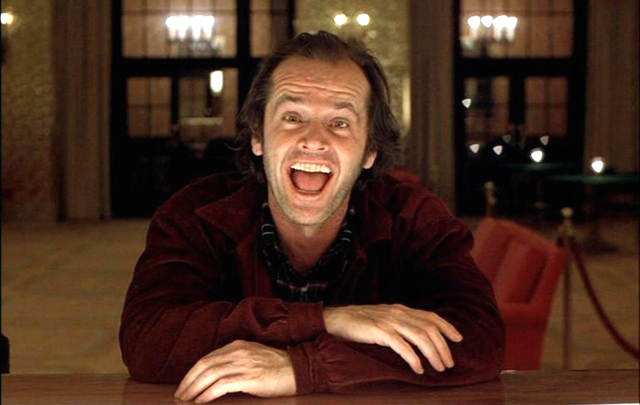
Though the film is now regarded as somewhat of a masterpiece of horror cinema, at the time, cinephiles felt like they had sorely missed something in The Shining, whose stylistically Kubrickian elements seemed trump by the bland narrative. But it was just that lack of a philosophically challenging narrative in The Shining that led the interviewees of Room 237—Rodney Ascher’s terrific and haunting essay-film that explores five fan’s obsessive theories about the deeper meanings of the film—to go back again and see if they missed something. And again. And Again (and probably a few more hundred “agains” considering the sheer scrutiny of details expelled in the film).
Composed entirely of clips from The Shining and the rest of Kubrick’s oeuvre, the film breeds its narrative by splicing together voiceovers of the five experts as they explain each one of their crackpot theories. According to each of them, The Shining is either: about the genocide of the Native Americans; a deeply sub-texted metaphor for the Holocaust; a trolling film of sorts about displacement; a film that’s (for some reason) meant to be played both backward and forward at the same time; or, Kubrick’s deeply coded admission to helping fake the Apollo 11 moon landings. Yeah, the theories are about as cockamamie as 9/11 truther videos.
But, Ascher’s film isn’t trying to convince you about any of these theories, nor is he making an exploitative look at crazies spouting their crazy ideas. Instead, Ascher’s film succeeds as a testimony to the intoxicating, alluring, and sometimes obsessive power of cinema. The conscious choice to never show the film’s subjects, but instead layer their narration over a brooding, kitschy electronic score (courtesy of Jonathan Snipes
William Hutson) gives it an experimental, almost transgressive feel. It’s as if you’ve stumbled upon some bizarre 1980s public-access program. You know, the kind of weird, cult stuff they only play in the wee hours of the night.
Listening to each of the film’s subjects explain the reasoning behind their conclusions of what The Shining is really about, you get the exhaustive sense of just how many times they’ve seen the film. Such minor details as the food label of a can in the film’s early kitchen scenes, or the brand of typewriter that Jack slaves his one-sentence novel over might seem like arbitrary details, but the subjects are so convincing that, at times, you might find yourself questioning “but what if?” It’s because, as the film rightly points out, Kubrick himself was such a cinematic perfectionist—setting up every scrutinous detail of a given set to serve some sort of purpose or message—that you’re left wondering why such glaring errors and impossibilities in The Shining are the way they are (the film probably contains the most scrutinous dissection of luggage and magazines you’ll ever encounter).
Like The Shining (or any of Kubrick’s films for that matter), there’s deeper meanings to be found in Room 237. As a documentary, it’s a wholly satisfying and original vision of how mesmerizing and mystifying The Shining is, but it’s also a cinematic rubix cube, and one that certainly does Kubrick’s legacy justice. If Ascher isn’t trying to convince us of any of his subject’s weird theories, what exactly are we meant to take away from his film? Maybe, like Kubrick, he just wants us to get lost in the narrative.
***
Room 237
Directed by Rodney Ascher
Produced by Tim Kirk
Featuring Bill Blakemore, Geoffrey Cocks, Juli Kearns, John Fell Ryan, Jay Weidner
Running time 104 minutes
Not rated
Opens today at West End Cinema (2301 M Street NW).