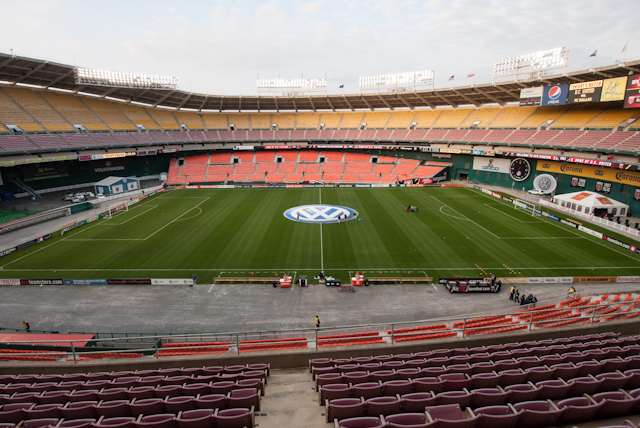
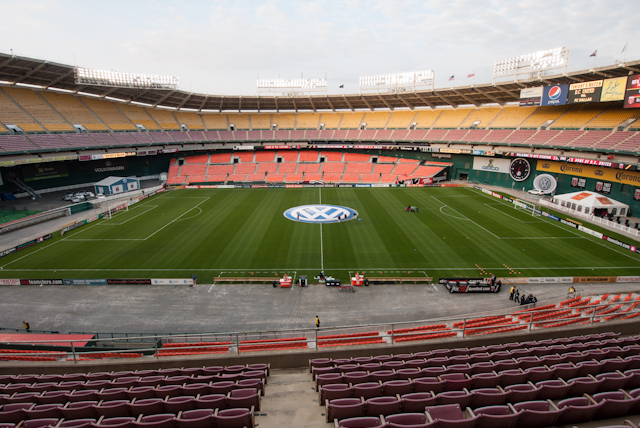
With tomorrow’s special election rapidly approaching, it feels like we’ve learned almost everything there is to know about the six candidates vying for an At-Large seat on the D.C. Council. But lost in a deluge of questions—they’ve ranged from “How do we fix the District’s troubled school system” to “Which jam bands are playing Zukerberg’s Four 20 concert?”—is an issue that seems primed to thrust itself to the forefront of the local political scene: D.C. United’s continuing quest to build a stadium at Buzzard Point.
Though the details and financial particulars of the agreement are still being worked out, the general architecture of the deal has been known for some time. United has suggested it would fully finance the stadium itself, while the District would lend a hand in other areas, such as acquiring the land, which is presently owned by Pepco and the development firm Akridge, and chipping in to subsidize infrastructural costs.
Though long a polarizing issue, the idea of using any public funds to keep United in the District has grown far more popular in recent times, and the club enjoys widespread support among the D.C. Council’s current members. Tommy Wells (D-Ward 6), whose ward includes the proposed stadium site, attended a recent match as a guest of United co-owner Jason Levien, who’s been handling United’s negotiations with the city. A “sense of the council” resolution introduced last year to show support for the idea of keeping the team based in the city passed overwhelmingly, with the lone voice of dissent provided by current D.C. Council Chairman Phil Mendelson, who expressed his concern over what he called the resolution’s “vague” language.
Even Mayor Vince Gray, who has in the past expressed reservations about a deal, has more recently taken to tweeting his support of keeping United and is said to have had a good relationship with the club during their negotiations.
So, what do the six candidates vying for the At-Large seat have to say about a United stadium proposal? Aside from the incumbent, Anita Bonds, who didn’t respond to requests for an interview, all showed an eagerness to support efforts to keep United in the District. Here are their comments.
 Patrick Mara: I am very supportive of efforts to keep D.C. United in D.C. The stadium itself would mean greater jobs for District residents and increased tax revenue for the city. A stadium would also create a new neighborhood by encouraging development in an underdeveloped, less densely populated part of the city.
Soccer is a sport that brings diverse communities together. It also attracts fans and visitors from around the world. In fact, building a soccer stadium would even encourage more international events to take place in D.C. such as the Olympics or other large scale sporting events that rely on multiple stadiums.
 Elissa Silverman: I am supportive of D.C. United; I’ve been to a few games and it’s quite exciting even though I grew up a baseball and college basketball fan.
I would be supportive if the team paid for the stadium, but I’d want to make sure the location was right for this use. I think the Verizon Center is a great example of how to use a sports facility for economic development; FedEx Field is a bad example. We want to make sure we have a Verizon-type development, not a FedEx one.
 Matthew Frumin: First let me say that like other residents, I appreciate all the work United has done in the city supporting reading and literacy programs in Wards 7 and 8 as well as the countless soccer clinics they have produced here and across the region. I also admire the team for being the most successful in Major League Soccer history, winning four championships over the last 17 years.
I fully support the team in their efforts to self-finance the construction of the stadium along with the city being responsible for infrastructure investment and costs. I have not seen the details of an agreement but conceptually I believe this is a good deal for the both the team and the city. Buzzard Point is an ideal place to locate the proposed stadium and it will catalyze projects in and around the baseball stadium.
When considering any project that involves public money (in this case in the form of infrastructure investment) I will use the same criteria I have used on other large projects I have been a leader on including the Wilson High School reconstruction by asking these three questions: Is the return on investment strong? Are the project plans realistic and fair to any neighboring communities? Will the project improve the quality of life for District residents overall?
So, if and when there is a specific proposal for a D.C. United stadium in the District, I will analyze that proposal using those criteria. That said, I do think there are substantial benefits to having D.C. United in the city and continuing its winning tradition and service to the community. The District is an international city that brings people from around the world and soccer is the world’s most popular sport and the most widely played sport in the United States, we need a first rate facility that is funded by the team and I will be pleased to work with their new ownership group to try to be a part of making this happen.
 Perry Redd: If indeed the current deal looks as you describe (as I haven’t closely follwed the negotiations) I would likely support the stadium being fully funded by the D.C. United franchise, and the city acting in partnership by providing the land—I’d propose the current RFK-D.C. General site and providing infrastructural support to solidify the deal—only adding a 30-year lease to the team to revert fully back to the District around 2040.
Paul Zukerberg: I love D.C. United and would love for them to have a new stadium. I’d have to review any proposal to see if it’s a good deal for taxpayers