Here’s an interesting historical tidbit to discuss over dinner (preferably with fava beans and a nice Chianti): Turns out, early settlers were also cannibals.
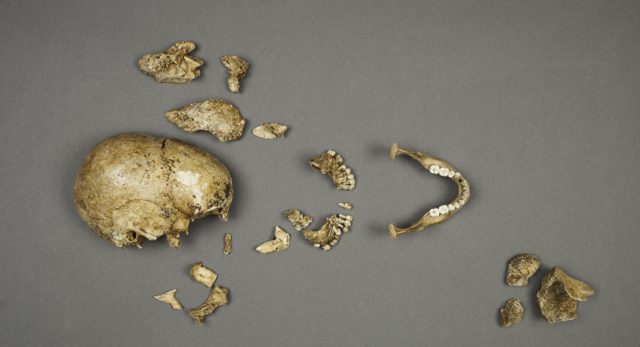
Earlier today, Douglas Owsley, the head of physical anthropology at the Smithsonian’s National Museum of Natural History, presented a forensic analysis of a set of 17th-century human remains proving that cannibalism took place during the colonization of Jamestown, Va.
According to the report, Owsley—who’s been working closely with archeologist William Kelso and his team from the Jamestown Rediscovery Project at Preservation Virginia to better understand the lives of colonial settlers—unearthed a peculiar skull in 2012 that, upon further study, led to the findings of today’s report.
The skull, which belonged to a 14-year-old girl nicknamed “Jane,” contained four shallow chops to the forehead that first led researchers to believe she had been a victim of cannibalism. Those shallow chops, Owsley and his team concluded, were a failed first attempt to open the skull. Further investigation of the odd indentations on the skull revealed that “the back of the head was then struck by a series of deep, forceful chops from a small hatchet or cleaver. The final blow split the cranium open. Sharp cuts and punctures mark the sides and bottom of the mandible, reflecting efforts to remove tissue from the face and throat using a knife.”
Further scientific analysis of “Jane’s” tibia confirmed Oswley’s teams theories that indeed, cannibalism totally went down in the early days of colonization in Jamestown. The most likely theory for this is because the harsh winters caused starvation and led to some apparently desperate circumstances.
“The desperation and overwhelming circumstances faced by the James Fort colonists during the winter of 1609-1610 are reflected in the postmortem treatment of this girl’s body,” Owsley said in a news release announcing the research.
Though a combination of digital imaging and medical technologies led researchers to determine a great deal about the details of “Jane’s” life, they were unable to determine the exact cause of death from the remains.
Researchers were also able to reconstruct the girl’s likeness through forensic facial reconstruction by scanning the incomplete remains of the fragmented skull and digitally piecing together a virtual model. Further digital rendering of the skull was used to create “Jane’s” forensic facial reconstruction of the girl’s likeness that, along with her story, will go on display on Friday in the Museum of Natural History’s “Written in Bone: Forensic Files of the 17th Century Chesapeake.”