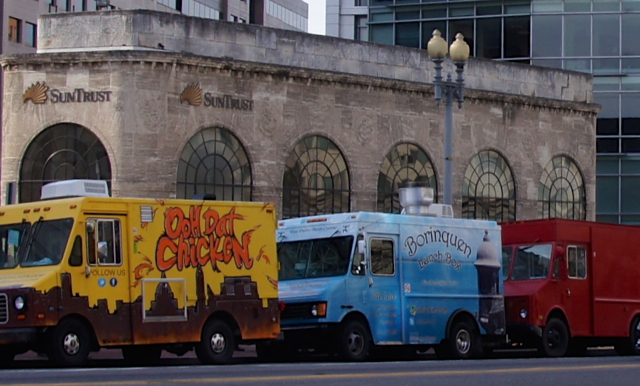
 Photo by Ted Eytan
The Restaurant Association Metropolitan Washington is accusing D.C.’s food trucks of “visually misleading” customers about the effects that the city’s proposed regulations would have on mobile vending. In a lengthy email today, RAMW states that it supports the current draft of food truck regulations, the fourth revision since Mayor Vince Gray first proposed issuing rules governing food trucks more than a year ago.
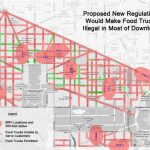
The current draft of the proposed rules would create 23 designated mobile vending zones throughout the city for which D.C.’s fleet of more than 100 food trucks would enter a monthly lottery to set up shop. The lottery zones are clustered around the city’s busiest parts during the workday, such as Farragut Square, Foggy Bottom, L’Enfant Plaza, and Chinatown. Trucks that do not win lottery spots could park elsewhere, but would have to keep beyond a 500-foot radius from the designated zones.
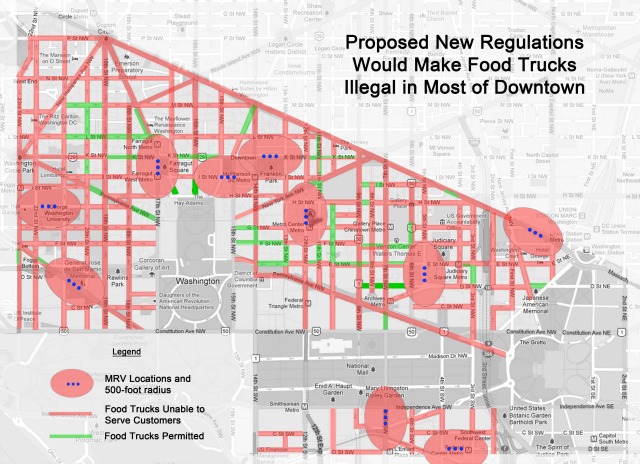
In response to this proposal, the Food Truck Association of Metropolitan Washington said such a system would leave lucrative parts of D.C. off-limits to many food trucks, possibly compelling them to seek out business in neighboring jurisdictions with more relaxed regulations.
But RAMW is standing firmly behind the current draft regulations, and says the above map, which was created by the Food Truck Association, is a fraud. “This map is not only visually misleading, but patently false,” RAMW’s email reads. “On the map, these ovals are colored red, implying that food trucks may not vend there. To the contrary, these especially designated areas for food trucks have NO LIMIT in the regulations on the number of food trucks that may vend there. Instead, there is a minimum of three trucks allowed, but no maximum.” (Emphasis RAMW’s.)
Doug Povich, the executive director of the Food Truck Association of Metropolitan Washington, could not be reached for comment.
RAMW has its own map, which, in addition to being in sharper relief, states that the overall number of lottery-generated mobile vending spots is not set yet.
The email also reminds that RAMW is one of many stakeholders in the food truck regulation process, which has also drawn input from neighborhood associations and business improvement districts around Washington, and says that it was the Food Truck Association that came up with the idea of offering dedicated parking spots on a rotating basis.
The Food Truck Association was recently backed up by other trade groups from around the United States that represent mobile vendors. A letter signed by 10 food truck organizations argued that D.C.’s regulations would “represent some of the worst food truck laws in the county” and upend the District’s emergence as one of the most vibrant food truck markets.
The D.C. Council is scheduled to hold a hearing on the proposed regulations next Friday. Until then, though, the most interesting salvo in RAMW’s letter might be the inauguration of the hashtag wars. Food trucks and their loyalists in recent weeks have been punctuating their tweets with “#savedcfoodtrucks”; a similar ad campaign is also appearing on the sides of Metro buses. Now, RAMW is getting into the 140-character fight with its own hashtag, “#readtheregs.”
No word if Councilmember Vincent Orange (D-At Large), who chairs the Committee on Business, Consumer and Regulatory Affairs, will take into account which side has more hashtags when next week’s hearing is convened.
UPDATE, 5:53 p.m.: Povich, of the Food Truck Association of Metropolitan Washington, says in an interview that RAMW’s letter is to be expected considering many of the responses to the proposed regulations. “It’s a reaction to the groundswell of support that we’re getting,” he says, citing statements put out by Councilmembers Mary Cheh (D-Ward 3) and David Grosso (I-At Large). The Washington Post’s editorial board this week also rejected the proposed regulations, writing that the rules, as currently written, “are threatening to choke [food trucks’] growth.”
“I would expect some pushback,” Povich says. “We’ve got a ton of support.” He claims that 95 percent the public comments filed to the Department of Regulatory and Consumer Affairs side with the food trucks.
And as for RAMW’s claim that the Food Truck Association’s map of the suggested mobile vending zones paints a false analysis, Povich stands by his group’s cartography. “They’re just wrong,” he says. “If there’s anybody that is out in the streets, if there is anybody who has measured all of the sidewalks, it’s the food trucks.”