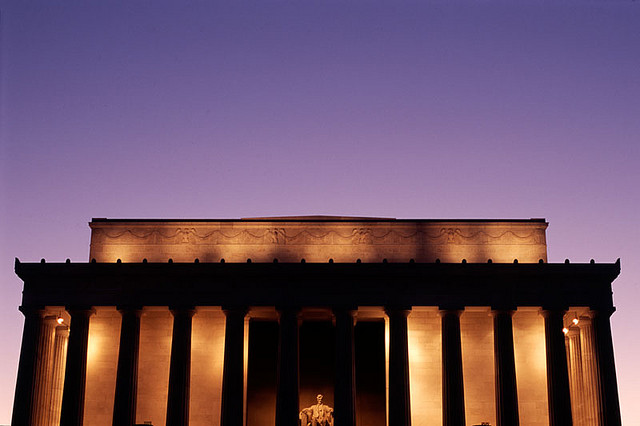
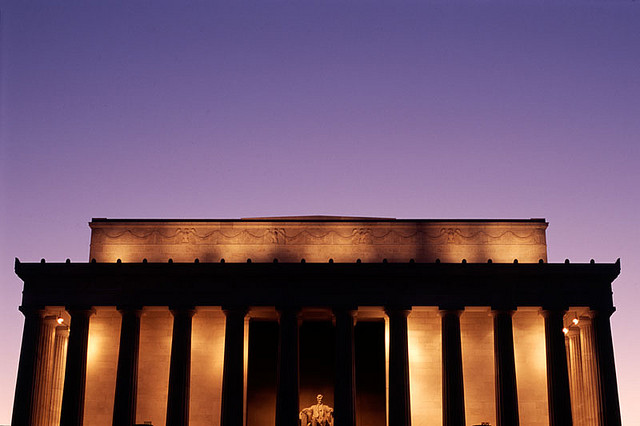
 Photo by Elliott Teel
By DCist contributor Julia Langley
On May 30, 1922 the Lincoln Memorial was dedicated on the west end of the National Mall. Designed by Henry Bacon, the monument is a leading example of the successful adoption of classical design in civic commemorative architecture.
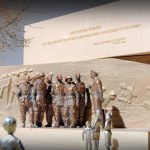
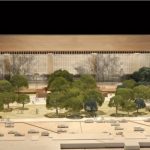
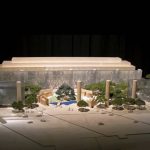
As the brouhaha over Frank Gehry’s design for the Dwight D. Eisenhower Memorial continues, the Lincoln Memorial serves as a perfect case study. The building, the sculpture of Lincoln by Daniel Chester French, and the paintings by Jules Guerin are each brilliant in their referencing of classical art forms. Combined, the memorial’s elements reference the ancient roots of U.S. democracy while delivering a thoroughly modern message of freedom, unity and shared governance.
Herein lies the memorial’s genius. Modeled on the form of a Greek temple, like the Parthenon in Athens, the monument to Lincoln was modified in critical ways that negated the original religious implications of the structure and recast it as a shrine to democratic ideals. Bacon shifted the orientation of the building so that entrance to the interior rooms is on the long side instead of the end. Inside, in place of a statue of a god is a sculpture of a man.
Daniel Chester French’s sculpture of Lincoln shows the 16th president wearing contemporary clothes, with rumpled hair and gaunt cheeks. He is neither deified nor idealized. French’s monumental sculpture presents us with a 19th-century hero whose deep convictions helped craft a country where “all men are created equal.” Lincoln’s words inscribed on the two smaller chambers and illustrated with Guerin’s paintings enhance the focus on Lincoln’s achievements.
The Lincoln Memorial’s success lies in its ingenious reinvention of classical form and not in the form itself. Classical art and architecture, without being properly contextualized, runs the risk of saying the opposite of what it means to say. An example of this is the winning entry in a contest last year to find an alternative design for the planned Eisenhower Memorial.
The winner of the contest, which was put on by the National Civic Art Society, proposed a triumphal arch (or two) resembling the Arch of Titus in Rome. On the façade it features sculptures of Eisenhower as both a military commander in uniform and as president in civilian clothes. Like the Arch of Titus, the proposed arch also presents winged victory figures holding laurel wreaths, an inscription to the deceased and engaged Corinthian columns.
In form and function, the project does not appear to deviate much from its Roman model. Because the Arch of Titus was built to commemorate the reign of a sovereign leader and celebrate both his military victories as well as his proscribed divinity, this is highly problematic. The winning artist in the National Civic Art Society’s contest, through his slavish imitation of the classical idiom, suggests that Eisenhower is like Titus—a godlike ruler who held absolute power over his people. For this to commemorate our 34th president, a modest man who led the world in a fight against tyranny, the message couldn’t be more misguided.